
Selected Stock Price Target News — June 29, 2026
Monday’s analyst tape covered three stocks. Each told a different story. Applied Materials picked up four target raises before the open. The new numbers ran from $700 to $850. Synaptics split the room instead. One firm lifted its target to $160. Another cut its rating the same week. onsemi’s buyout offer still hangs over that stock. Incyte drew a Buy reiteration at $140. That target sits a full $27 above where UBS parked its own number days earlier. Three stocks, three shapes of disagreement. Underneath each target sits a hit rate. Those are what we line up below.
New DRAM Tools Push Four Firms To Lift Applied Materials Targets Into A $700 To $850 Range
Four target increases landed on Applied Materials in a single morning. Applied Materials makes the equipment that deposits, etches, and patterns the layers on a silicon wafer. That process turns the wafer into working memory and logic chips. The company posted fiscal second-quarter revenue of $7.91 billion in mid-May, a record. Non-GAAP earnings came in at $2.86 a share. The move traces to June 25. That day Applied rolled out six new systems aimed at DRAM manufacturing and advanced packaging. DRAM is the memory that sits next to a processor. Advanced packaging is the stitching that binds several chips into one module for AI servers. Both are where the spending is going right now. So the equipment orders follow the spending.
Cantor Fitzgerald’s C.J. Muse set the high mark. He raised his target to $850 and kept a constructive stance. Muse has reached 87.22% of his past targets across 484 calls. His average call has carried about 25% upside before it gets there. So the high number isn’t a flier from someone who misses a lot. KeyBanc’s Steve Barger moved to $750 the same morning. Barger’s met ratio sits at 88.37% over 573 documented calls, the steadiest record of the group. B. Riley went to $790. Wells Fargo’s Joe Quatrochi lifted his number to $740 while keeping an Overweight rating. Three days earlier, Evercore ISI’s Mark Lipacis had already pushed his target to $700 from $515, a $185 jump. His 87.14% met ratio over 887 calls is one of the longer track records in semiconductors.
The Order Book Behind The Targets
The launch gave the firms something concrete to model. Applied framed the six new systems around DRAM and packaging steps. AI memory and chiplet designs depend on both. The pitch is simple: more of each future server’s bill of materials passes through Applied’s tools. That idea drives every one of these notes: more capital equipment per AI rack, with Applied taking a slice of it. None of the analysts are forecasting the share price directly. They’re reading the order book behind it instead. It’s a bet on how many of those tools get bought.
The spread is narrow by intent. The four fresh targets sit between $740 and $850. Lipacis’s $700, though, is the floor. Every one of these analysts has reached past targets at least 87% of the time. Barger clears 88%. When the high and the low of a target cluster both come from analysts who hit most of their calls, the range carries weight on its own. These aren’t names that scatter their numbers and walk away. They usually land close to where they aim. That makes the $150 gap from Lipacis’s $700 floor to Muse’s $850 top meaningful. Still, it isn’t something to average away.
The Pending onsemi Deal Splits Synaptics Analysts As Wells Fargo Raises And Barclays Cuts
Synaptics got pulled in two directions the same week. Wells Fargo’s Joe Quatrochi lifted his target to $160 and held Overweight before Monday’s open. Hours earlier, though, Barclays had gone the other way. Synaptics makes the touch, display, and edge-AI chips used in phones, cars, and other connected devices. The company posted fiscal third-quarter revenue of $294.2 million in May, up 10% year over year. Non-GAAP earnings came in at $1.09 a share. In late June, Synaptics agreed to be bought by onsemi (ON). That all-stock deal is worth roughly $7 billion. A pending acquisition changes what an analyst rating even measures. The stock now trades against deal terms more than against next year’s earnings.
Barclays analyst Tom O’Malley downgraded Synaptics to Equalweight. He stepped back now that the upside is mostly defined by the exchange ratio rather than the business. O’Malley has reached 82.5% of his targets across 579 calls, almost all of them in technology. The call isn’t a casual one. Craig-Hallum’s Anthony Stoss had raised his target to $145 three days earlier. Stoss carries a 71.39% met ratio over 616 calls, with the widest average upside of this group at roughly 31%. Wells Fargo sits at the top of the visible range at $160. Put those together and you get a $145-to-$160 band of targets with a rating cut layered on top.
The Deal Terms Behind The Split
The onsemi deal is why the readings diverge. When a buyer offers stock, a target stops being a clean view of fundamentals. It becomes partly a bet on the acquirer’s shares and the odds the deal closes. A firm raising its Synaptics target toward $160 is, in effect, marking the combined company higher. A firm cutting to Equalweight, though, is saying the easy move between here and the deal price is largely spoken for. Both can hold at once. That’s why the rating and the target point opposite ways this week.
The split is about timing, not the quality of the company. O’Malley’s downgrade and Wells Fargo’s raise aren’t arguing over whether Synaptics builds good silicon. They’re arguing about how much room is left in the stock before onsemi’s terms set the ceiling. AnaChart tracks both analysts’ histories on tech names. O’Malley’s record on tech calls gives his step-back some standing. Acquisitions tend to produce splits like this: narrow, and about timing rather than the business.
Incyte’s Target Range Runs From $113 at UBS to $140 at H.C. Wainwright
Incyte’s bulls and bears are $27 apart on the same biotech. H.C. Wainwright’s Mitchell Kapoor reiterated a Buy and a $140 target on Monday, the high end of the recent range. UBS’s Ashwani Verma had raised his number to $113 three days earlier while staying Neutral. Guggenheim sat between them at $136. Incyte is a Wilmington, Delaware drugmaker known for the JAK inhibitor Jakafi and the Opzelura skin cream. The company posted first-quarter revenue of $1.27 billion in April, up 21% year over year. GAAP net income came in at $303.3 million. Meanwhile, it has spent June clearing two overhangs that analysts had been watching.
Kapoor’s $140 is the most bullish published target. It comes with a met ratio of 40.84% over 716 calls, and an average upside near 58% on his healthcare names, the lowest hit rate of any analyst in today’s update. UBS analyst Ashwani Verma sits at the cautious end, with a $113 target, a Neutral rating, and a 59.53% met ratio across 320 calls. Guggenheim’s $136 fills the middle. So the same stock carries a Buy at $140 from an analyst who reaches four in ten of his targets. It also carries a Neutral at $113 from one who reaches closer to six in ten. The hit rates run opposite to the price targets.
The Catalysts Behind The Split
Two catalysts moved underneath the calls. On June 13, Incyte reported Phase 3 frontMIND data. The data showed its drug tafasitamab, paired with lenalidomide, cut the risk of disease progression by about 25% in first-line patients. That readout widened the pipeline beyond Jakafi. A week ago, the company settled its lawsuit with the Centers for Medicare and Medicaid Services over Opzelura’s Medicaid rebate rules. That took a legal question off the table. So a trial win and a settlement in the same month give the bulls and the bears different things to weigh. That’s part of why the targets sit so far apart.
So the gap is real: two track records, two different reads. Kapoor’s Buy at $140 comes from the analyst with the lower hit rate. Verma’s Neutral at $113 comes from the one with the higher hit rate. A bullish target from the less accurate analyst and a cautious one from the more accurate analyst don’t collapse into a single read. AnaChart doesn’t try to collapse them either. On Incyte, the records and the targets pull in opposite directions. The $27 spread carries more information than its midpoint alone.
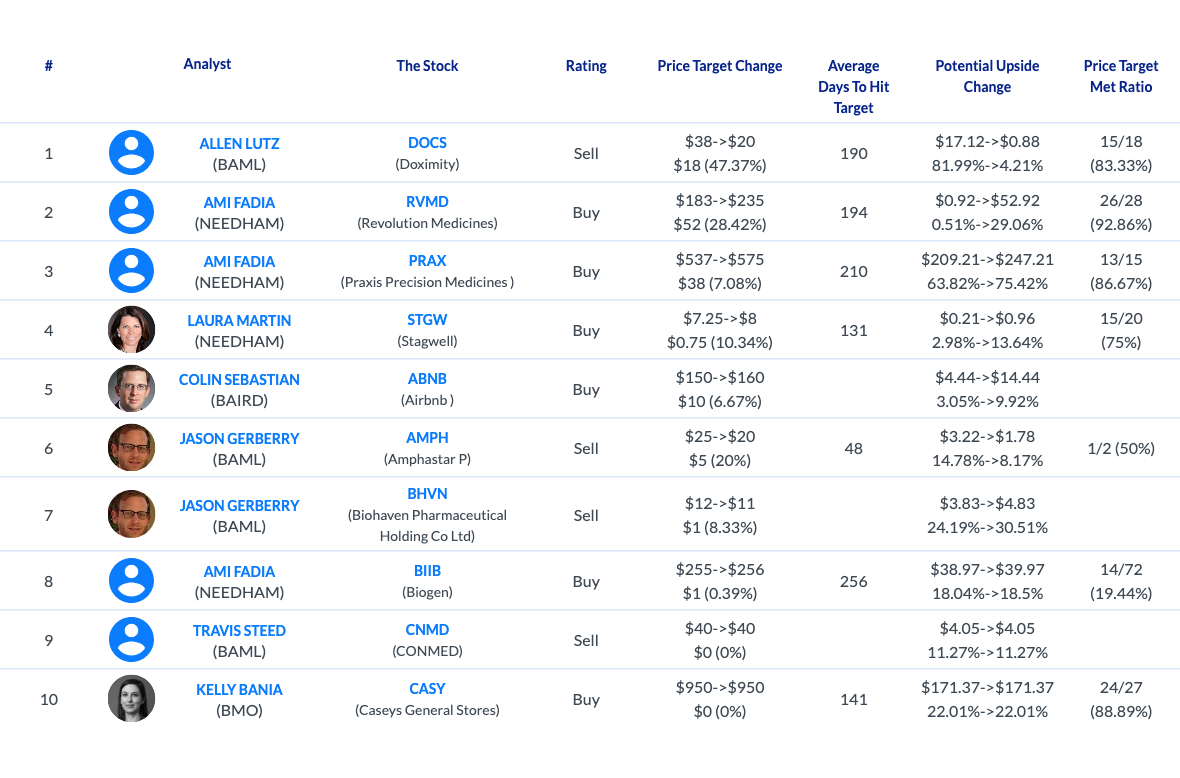
Today’s targets and ratings came from Cantor Fitzgerald, KeyBanc, B. Riley, Wells Fargo, Evercore ISI, Barclays, Craig-Hallum, H.C. Wainwright, UBS, and Guggenheim. They span chip equipment, edge-AI silicon, and biotech. AnaChart tracks how often each of those firms’ analysts actually reach the targets they set. The dataset runs to 661,383 price targets and 759,654 ratings across 7,191 analysts and 9,686 tickers, eighteen years of calls kept with their original sources. Targets go public within minutes. A record like Muse’s 484 tracked calls, though, takes years to build. For the full picture, the analyst price target dataset carries every call in one place.