D-Wave, Rigetti, MAA Price Targets, November 11 2026
D-Wave
D-Wave Quantum builds quantum computers and sells access to them through the cloud. Its current systems run under the Advantage2 name. The company is based in Palo Alto, California. It reported third-quarter results this week. Revenue came to $4.51 million, 3.4% above the $4.36 million consensus. Its loss was $0.13 a share, a 30% wider loss than the $0.10 expected.
What Drove D-Wave’s Quarter
Revenue grew 21% from a year earlier. The mix shifted. Subscription revenue from its Leap cloud service grew 56% to $2.2 million. Professional services grew 318% to about $2.0 million. Management said most of that came from work for a Fortune 100 customer and paid gate-model research. System sales came to about $360,000, roughly $1.5 million less than a year earlier.
The company said professional services carry a lower margin. The GAAP gross margin was 52.9%, against 71.4% a year earlier. Meanwhile, operating expenses grew 84% to $55.9 million. Research and development took $31.5 million of that, against $14.1 million. Personnel costs alone added $12.3 million. The adjusted EBITDA loss widened to $37.7 million from $20.6 million.
The net loss narrowed to $48.2 million from $140.0 million. But the year-earlier figure carried a $121.9 million charge for remeasuring warrants. D-Wave ended the quarter with $503.4 million in cash and marketable securities.
D-Wave’s Bookings and Deals
Third-quarter bookings shrank 19% to $1.9 million. The company said single quarters swing with the timing of large deals. Over nine months, bookings grew 611% to $37.4 million. That total includes a $20 million system sale to Florida Atlantic University. D-Wave expects most of that revenue in the fourth quarter. Remaining performance obligations stood at $38.3 million, and about 59% should be recognized within a year.
Abroad, an Advantage2 system went into Villa Saporiti in Como, Italy, in October. Swiss Quantum Technology funded it. In Japan, NTT DOCOMO is running a second production application. LG CNS signed a memorandum of understanding in South Korea. At home, D-Wave has an agreement for up to $100 million in CHIPS Act funding, paid against milestones. None had been received by the end of September.
Five Desks Cut D-Wave
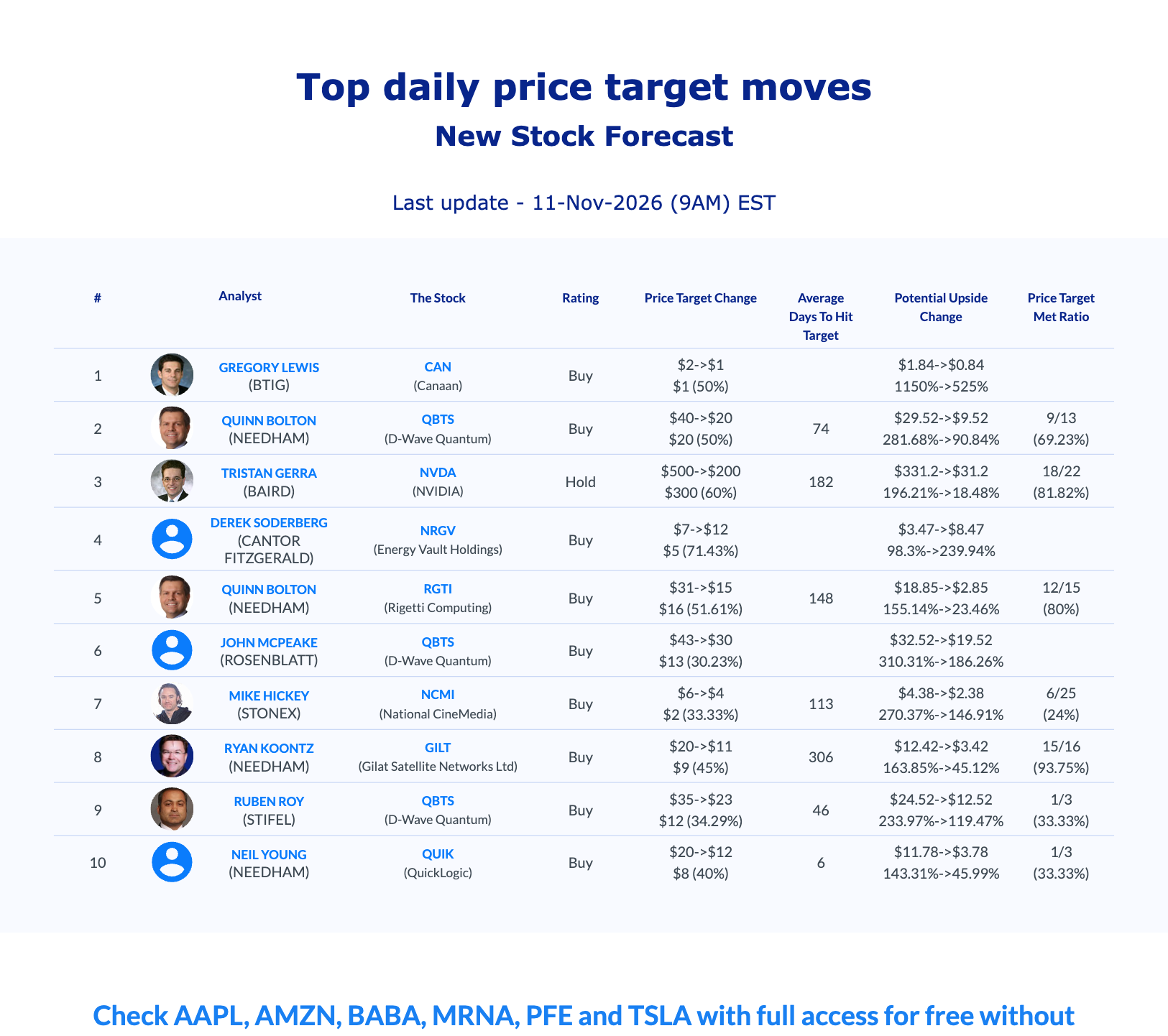
Mark Lipacis of Evercore kept Outperform and lowered his target from $37 to $27 today. Gary Mobley of StoneX kept Buy and lowered his target from $30 to $20. Quinn Bolton of Needham kept Buy and lowered his target from $40 to $20. Ruben Roy of Stifel kept Buy and lowered his target from $35 to $23. Kingsley Crane of Canaccord lowered his target from $35 to $31.
D-Wave’s Record on AnaChart
D-Wave draws 12 covering analysts on AnaChart. Their average target is $38.84. All of them rate it Buy. AnaChart’s tracking shows 58.05% of D-Wave targets get met. That takes about 99 days on average.
Rigetti
Rigetti Computing builds superconducting quantum computers and the chips inside them. It sells full systems to government and research labs. In addition, it rents time on its machines through the cloud. The company is based in Berkeley, California. It reported third-quarter results this week. Revenue came to $1.41 million, 61.6% below the $3.67 million consensus. Its adjusted loss was $0.06 a share, a 20% wider loss than the $0.05 expected.
What Drove Rigetti’s Quarter
Revenue shrank 27% from $1.95 million a year earlier. Chief financial officer Jeff Bertelsen pointed to the timing of system deliveries, customer acceptance milestones and government-funded programs. He said a small number of contracts drives each quarter. One customer accounted for 34% of third-quarter revenue. Over nine months, revenue grew about 110% to $10.9 million.
The gross margin was about 61%, against 21% a year earlier. Bertelsen said margins move with contract mix, pricing, system configuration and hardware timing. Operating expenses grew to $34.0 million from $21.0 million. Research and development accounted for $25.5 million of that, a 70% increase. The operating loss came to $33.2 million.
The GAAP net loss was only $3.1 million, against $201 million a year earlier. Both figures carry noncash fair-value changes on warrant and earnout liabilities. Rigetti ended the quarter with $497.1 million in cash and investments, against $541.3 million at the end of June. It has no debt.
On the technical side, its Cepheus-1-108Q system posted 99.5% median two-qubit fidelity. It links 12 nine-qubit chiplets. Smaller sections of the chip posted 99.6% on 80 qubits and 99.7% on 50. The next target is more than 300 qubits by mid-2028.
Rigetti still targets about $20 million in 2026 revenue. That implies about $9.1 million in the fourth quarter. It depends on C-DAC, India’s Centre for Development of Advanced Computing, accepting a system. Separately, the Commerce Department agreed to provide up to $100 million for readout electronics, cryogenic capacity and chip fabrication. The government receives about 7.7 million shares in return. Nothing had been drawn by September.
Three Desks Cut Rigetti
Quinn Bolton of Needham kept Buy and lowered his target from $31 to $15 today. Kevin Garrigan of Jefferies lowered his target from $18 to $12. Gary Mobley of StoneX kept Buy and lowered his target from $25 to $20.
Rigetti’s Record on AnaChart
Rigetti draws 9 covering analysts on AnaChart. Their average target is $31.21. Ratings split 84.62% Buy and 15.38% Hold. AnaChart’s tracking shows 59.27% of Rigetti targets get met. That takes about 101 days on average.
MAA
Mid-America Apartment Communities owns and runs apartment communities, mostly across the Sun Belt. It is a real estate investment trust based in Germantown, Tennessee. Rent is where its money comes from. It reported third-quarter results on October 28. Revenue came to $560.13 million, 0.3% above the $558.7 million consensus. Earnings were $0.72 a share, 6.5% below the $0.77 expected.
What Drove MAA’s Quarter
Core funds from operations, or core FFO, is the main cash earnings measure for a REIT. It strips out property depreciation. It came to $2.10 a share, against $2.16 a year earlier. In the same-store pool, revenue slipped 40 basis points while expenses grew 2.0%. Net operating income shrank 1.8%. The average rent was $1,691, 0.1% lower.
New leases signed 6.0% below the prior lease on the same unit. Renewals came in 5.3% higher. Blended, that is a 0.4% gain. Turnover stayed low at 39.6%, and only 10.1% of move-outs were to buy a house, a record low for MAA. Occupancy held at 95.3%.
Where MAA Gained and Lagged
By market, Charleston and Norfolk led on blended pricing. Austin has the most new supply in the portfolio, according to the company. Its blended pricing was 420 basis points better than a year earlier. Orlando improved by 100 basis points, and Dallas beat the portfolio. On the other side, Phoenix, Charlotte and Savannah are still absorbing new buildings. Charlotte added 19% to its apartment stock over three years. There, lease-ups offer up to 10 to 12 weeks free on some floor plans. Atlanta saw a burst of concessions in July around Brookhaven and Duluth. However, the company said Atlanta was back above 95% occupancy early in the fourth quarter.
MAA cut the midpoint of its 2026 core FFO guidance by $0.04 to $8.49 a share. Same-store revenue is now seen between a 0.40% and a 0.10% decline. Chief executive Brad Hill cited higher interest rates. He also said new-lease pricing is improving about a quarter later than planned. October blended pricing ran more than 100 basis points ahead of last October. Meanwhile, MAA has eight communities under construction, 2,236 units in all. It also sold a 269-unit Washington, D.C. property it owned 35% of, for about $147 million.
Two Desks Weigh In on MAA
Adam Kramer of Morgan Stanley downgraded MAA to Equal Weight from Overweight today. He lowered the price target from $147 to $134. Steve Sakwa of Evercore kept In-Line and raised his target from $121 to $122.
MAA’s Record on AnaChart
MAA draws 19 covering analysts on AnaChart. Their average target is $141.18. Ratings split 46.58% Hold, 43.84% Buy and 9.59% Sell. AnaChart’s tracking shows 55.61% of MAA targets get met. That takes about 356 days on average.
What the Performance Matrix Shows
Rigetti has the best met ratio of the three, and MAA the lowest. A met D-Wave target lands in about 99 days. By contrast, a met MAA target takes about 356. Coverage depth differs too. MAA has 19 covering analysts on AnaChart, against 12 for D-Wave and 9 for Rigetti. D-Wave is the only one of the three with no Hold or Sell rating. AnaChart’s first D-Wave forecast dates to August 2022. Its first Rigetti forecast dates to January 2022, and its first MAA forecast to September 2013. So MAA’s record runs more than eight years longer than the other two.
AnaChart tracks every price target against what happened to the stock afterward, desk by desk and analyst by analyst. The ticker pages linked above break out each record by analyst, firm and year. AnaChart’s full data set holds more than 760,000 analyst calls on more than 9,000 tickers, active and delisted. More than 680,000 carry a price target and more than 730,000 carry a rating. It is the second largest database of its kind. The raw file is available through the AnaChart store.
The previous update covered Rocket Lab, Trade Desk and Hims & Hers on November 10.