
Analyst Activity Before Major Stock Moves — What AnaChart Data Shows About Early vs Late Calls
By: Michael Muchugia
Analyst price target revisions often cluster around major stock events. Earnings releases, guidance updates, and sector inflection points all trigger activity. But timing separates these revisions unevenly.
Some analysts adjust their targets weeks before a catalyst. Others respond only after new information is already public. Using AnaChart’s dataset — which tracks whether analyst price targets are actually achieved — a consistent pattern emerges.
The distinction is not simply what analysts predict. It is when those predictions are made, and whether timing correlates with accuracy.
Pre-Move Revision Clusters
In several high-profile cases, analyst activity clusters in the weeks leading up to a major catalyst. This reflects diverging views on near-term execution and demand trends before results confirm them.
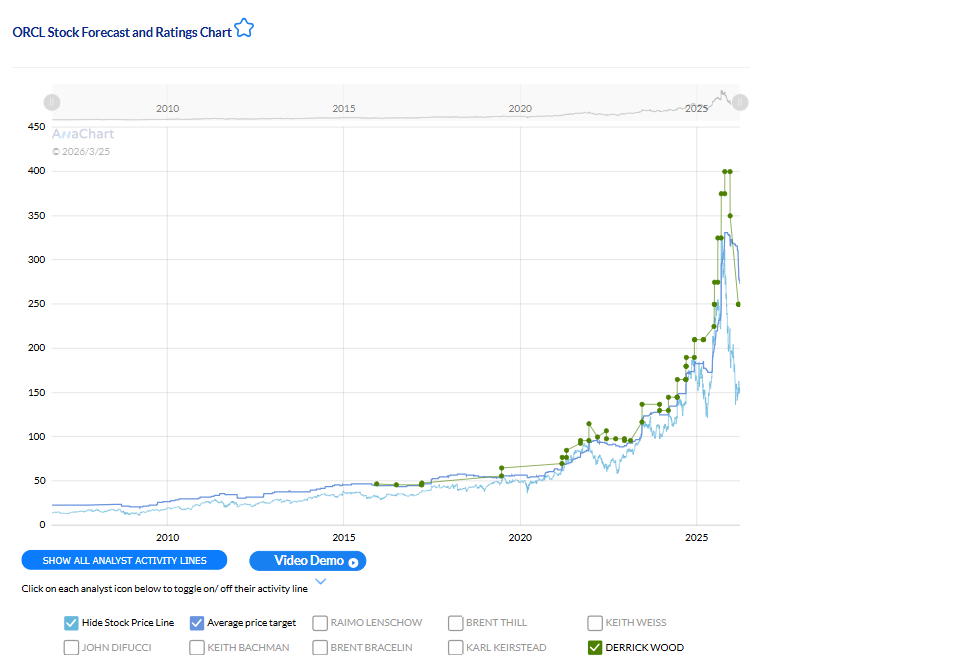
Ahead of Oracle Corporation‘s March 2026 earnings release, multiple analysts revised their price targets within a two-week window. Not all moved in the same direction.
Derrick Wood’s Early Call on Oracle
Derrick Wood (TD Cowen) stands out as an early mover. Ahead of the print, Wood lowered his price target to $160 from $195. He cited execution risk and weaker near-term demand signals.
That positioning proved directionally aligned with the more cautious tone following the earnings release. Several analysts who maintained higher targets into the event cut them only after results came out — moving closer to Wood’s earlier stance.
On AnaChart, Wood holds a 71% hit ratio on ORCL across 14 predictions. He continues to maintain a more cautious stance, keeping his target below the broader Street range.
Silent Periods Before the Move
Not all stocks show active revision behavior ahead of key events. In some cases, analyst activity stays muted leading into earnings. A concentrated wave of revisions follows only after results come out.
This pattern stood out around Micron Technology‘s earnings cycle. A subset of analysts maintained differentiated views ahead of the release. The broader portion of the Street adjusted targets only after results came out — incorporating information already public rather than anticipating it.
The absence of meaningful pre-event movement can itself signal limited conviction. Reactive revisions reflect updated guidance. They do not reflect forward-looking positioning.
Early Movers vs Late Movers
Across earnings cycles, a consistent pattern divides analysts who adjust targets ahead of events from those who respond only after results come out.
Joseph Moore’s Positioning on Micron
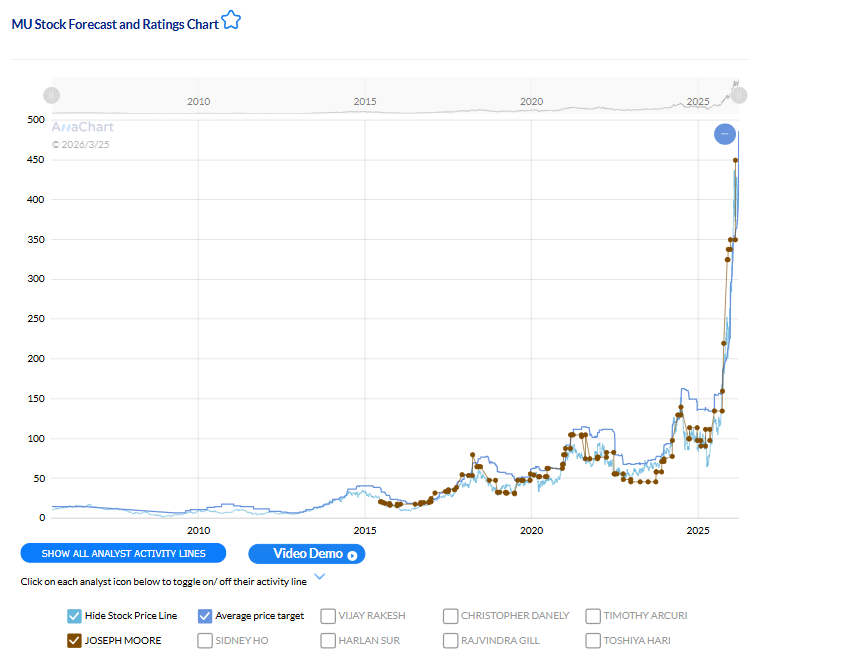
Ahead of Micron Technology‘s fiscal Q2 2026 earnings, Joseph Moore (Morgan Stanley) maintained a $450 price target and Buy rating. His view reflected confidence in long-term demand drivers in memory markets.
Micron subsequently reported fiscal Q2 revenue of $23.86 billion, nearly tripling from $8.05 billion a year earlier. Multiple analysts raised their targets only after the earnings release, reflecting updated guidance rather than forward-looking positioning.
Moore had already set that call ahead of the print. On AnaChart, he holds a 93.06% hit ratio on MU across 72 predictions, with an average return of 9.67% and 214 days to target.
Early movers introduce differentiated views before new information confirms them. Late movers adjust targets in response to information already available. From a predictive standpoint, the former carries more value.
Signal vs Noise in Analyst Activity
AnaChart data shows that not all analyst activity carries equal informational value. The frequency of price target revisions does not necessarily correlate with accuracy.
Analysts like Derrick Wood and Joseph Moore — who demonstrate strong hit ratios on AnaChart — tend to make fewer but more deliberate adjustments. They move ahead of major events rather than in reaction to them.
Timing and accuracy define signal — not revision frequency.
Oracle: Early Positioning Ahead of March 2026 Earnings
Oracle‘s earnings cycle illustrates how early positioning can diverge meaningfully from consensus. Derrick Wood (TD Cowen) lowered his price target to $160 ahead of the release, citing execution risks. That move stood out as one of the more conservative calls on the Street at the time.
Following the earnings release, multiple analysts adjusted their targets downward — aligning more closely with Wood’s earlier positioning. On AnaChart, Wood’s 71% hit ratio across 14 predictions on ORCL reinforces the consistency of his calls.
Micron Technology: Conviction Held Ahead of a Strong Print
Micron‘s earnings cycle highlights how conviction held ahead of a catalyst can differentiate analysts from the broader Street. Joseph Moore (Morgan Stanley) maintained a $450 price target and Buy rating heading into the release.
The company reported fiscal Q2 revenue of $23.86 billion. Analysts broadly raised their targets in response. But Moore had already set his positioning ahead of the print.
On AnaChart, his 93.06% hit ratio across 72 predictions on MU, alongside a 9.67% average return, reflects the consistency of that approach.
Conclusion
AnaChart data highlights a consistent pattern in analyst behavior: timing matters as much as direction. Pre-move revision clusters often contain early signals — particularly from analysts with strong track records. Silent periods reflect limited conviction and reduce predictive visibility.
Early movers tend to provide more forward-looking value than analysts who revise targets after events. Frequent revisions do not equate to accuracy. Conviction and historical performance drive signal.
The key distinction is not simply which analysts are bullish or bearish. It is which analysts move early — and whether those early calls prove correct.
AnaChart’s dataset provides a unique lens on this dynamic. It enables investors to evaluate not just analyst opinions, but the timing and accuracy behind those opinions. Explore analyst track records on AnaChart.