BILL, Alibaba, Walmart Price Targets, November 20 2026
BILL
BILL Holdings sells software that small and midsize businesses use to pay bills, get paid and manage company spending. It served 475,300 businesses at the end of September and took in $353.8 million of revenue in that quarter. The company is based in San Jose, California. On Thursday, November 19, after the close, BILL agreed to be taken private. The buyer is TPG, in partnership with the payments company Corpay. The cash deal pays $63.25 a share and values BILL at about $6.0 billion on a fully diluted basis.
What Drove BILL’s Deal
BILL last reported on November 5. Core revenue, from subscriptions and transaction fees, grew 14% to $316.4 million. Net income was $60.3 million, against a $3.0 million loss a year earlier. Non-GAAP earnings were $1.18 a share, 20.4% above the $0.98 expected. BILL also raised its full-year profit outlook.
The deal price is a 31% premium to BILL’s 60-day volume-weighted average price through November 16. That was the last full trading day before media reports of the talks. TPG will hold a majority stake through its TPG Capital fund. Corpay takes a minority stake. René Lacerte, BILL’s founder and chief executive, stays in the job. He said the deal delivers “significant, certain, and immediate value to our stockholders.”
The board approved the deal unanimously. Starboard Value, BILL’s largest stockholder, and Lacerte have agreed to vote for it. The deal needs stockholder and regulatory approval. It carries no financing condition. The companies expect it to close in the first half of 2027. Corpay chief executive Ron Clarke said his company sees “clear opportunities to support and complement BILL’s product roadmap.” TPG and Corpay also teamed up on AvidXchange, a $2.2 billion take-private agreed in May 2025.
Nine Desks Downgrade BILL
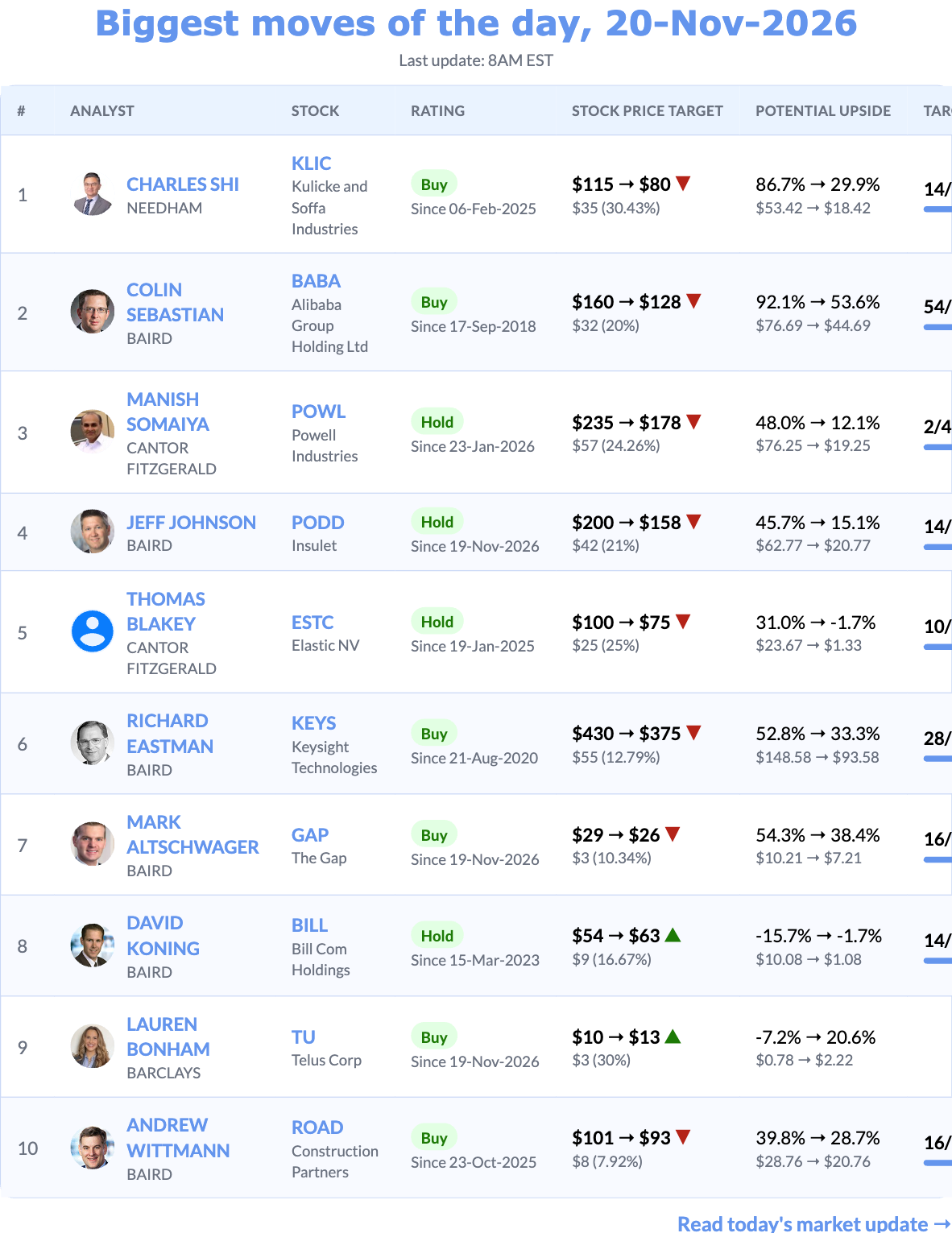
Nine desks downgraded BILL. Three of them set targets at or near the $63.25 deal price. Taylor McGinnis of UBS downgraded BILL from Buy to Neutral and cut the target from $64 to $63.25. Tien-Tsin Huang of JPMorgan downgraded it from Overweight to Neutral and moved his target from $60 to $63. Samad Samana of Jefferies downgraded it from Buy to Hold and moved his target from $62 to $63.25.
Scott Berg of Needham downgraded BILL from Buy to Hold. Andrew Harte of BTIG downgraded it from Buy to Neutral. Ken Wong of Oppenheimer downgraded it from Outperform to Perform. Andrew Schmidt of KeyBanc downgraded it from Overweight to Sector Weight.
Jared Levine of TD Cowen downgraded BILL from Buy to Hold today. On Thursday he had kept Buy and raised his target from $66 to $76. James Friedman of Susquehanna downgraded BILL from Positive to Neutral on Thursday, with a $73 target. David Koning of Baird kept Neutral and raised his target from $54 to $63.
Before today’s moves, BILL drew 18 covering analysts on AnaChart, with an average target of $59.37. Ratings split 58.18% Buy and 41.82% Hold. AnaChart’s tracking shows 61.82% of BILL targets get met, taking about 95 days on average. Levine has a met ratio of 2 of 3, and Friedman 2 of 11.
Alibaba
Alibaba runs the Taobao and Tmall shopping platforms in China, along with a cloud computing and AI business and the Taobao Instant Commerce delivery service. The company is based in Hangzhou and has a market value of about $207 billion. It reported results for the September quarter on Thursday, November 19. Revenue came to RMB 271.52 billion, 0.4% above the RMB 270.45 billion consensus. Adjusted earnings were RMB 8.10 per ADS, 24.2% below the RMB 10.69 expected.
What Drove Alibaba’s Quarter
Revenue came to about $40.5 billion (RMB 271.5 billion), 10% more than a year earlier. AI Cloud and Compute Services revenue grew 53%. Revenue from outside cloud customers grew 64%. Alibaba credited wider adoption of its AI products. Customer management revenue, the fees merchants pay on its marketplaces, shrank 5%. On a like-for-like basis, excluding contra revenue from a new business development program, it grew 1%.
Adjusted EBITA grew 260% to RMB 32.6 billion. Alibaba put that down to better results in Taobao Instant Commerce and the cloud business, along with cost savings. More spending on technology offset part of the gain. Net income grew 213% to RMB 64.4 billion, mainly on net investment income and higher operating income. Non-GAAP net income grew 92% to RMB 19.9 billion.
Chief executive Eddie Wu said Alibaba “will continue to bring technological innovations to our comprehensive AI stack.” Finance chief Toby Xu said the company will keep “disciplined investments in AI capabilities” while it targets positive free cash flow.
Nine Desks Weigh In on Alibaba
Five desks cut their targets. One raised, and three reiterated. Colin Sebastian of Baird kept Outperform and cut his target from $160 to $128 today. Alicia Yap of Citigroup kept Buy and cut her target from $193 to $160. Ronald Keung of Goldman Sachs lowered his target on Alibaba’s Hong Kong-listed shares to HK$156.
On Thursday, Thomas Chong of Jefferies kept Buy and lowered his target to $161. Bo Pei of US Tiger Securities kept Buy and lowered his target to $140. Wei Fang of Mizuho kept Outperform and raised his target to $205. Jiong Shao of Barclays reiterated Overweight with a $155 target. Shyam Patil of Susquehanna reiterated Positive. Today, Jim Kelleher of Argus reiterated Hold.
Before these moves, Alibaba drew 13 covering analysts on AnaChart, all rated Buy, with an average target of $193.86. AnaChart’s tracking shows 79.18% of Alibaba targets get met, taking about 457 days on average. Sebastian has a met ratio of 54 of 62, Patil 18 of 30, Chong 16 of 25 and Shao 16 of 25.
Walmart
Walmart runs Walmart stores in the U.S. and abroad and Sam’s Club, along with a growing online, advertising and membership business. The company is based in Bentonville, Arkansas, and has a market value of about $1 trillion. It reported third-quarter results on Thursday, November 19, before the market opened. Revenue came to $188.8 billion, 0.8% above the $187.27 billion consensus. Adjusted earnings were $0.65 a share, 1.6% above the $0.64 expected.
What Drove Walmart’s Quarter
Revenue grew 4.5% in constant currency. Walmart U.S. comparable sales grew 2.9% excluding fuel. Transactions grew 1.5%. The average ticket grew 1.4%. U.S. online sales grew 23%, and global online sales grew 17%. Global advertising grew 25%, led by 37% in the U.S. Membership fee revenue grew 17%.
Operating income grew 16.0%, or 5.5% on an adjusted, constant-currency basis. Chief executive John Furner pointed to “growing our core business and gaining market share.” Walmart raised its full-year outlook. It now sees constant-currency sales growth of 4.9% to 5.2%, up from 4.0% to 5.0% in August. It sees adjusted EPS of $2.84 to $2.89, up from $2.80 to $2.87.
Five Desks Weigh In on Walmart
Four desks raised their targets and one held. Simeon Gutman of Morgan Stanley kept Overweight and raised his target from $125 to $135 today. Christopher Nardone of BofA Securities kept Buy and raised his target to $141. Bobby Griffin of Raymond James raised his target from $130 to $140. Robert Drbul of BTIG reiterated Buy with a $140 target. On Thursday, Scot Ciccarelli of Truist kept Buy and raised his target from $114 to $134.
Walmart draws 31 covering analysts on AnaChart. Their average target is $135.62. Ratings split 99.28% Buy and 0.72% Hold. AnaChart’s tracking shows 91.35% of Walmart targets get met, taking about 308 days on average. Gutman has a met ratio of 77 of 80, Ciccarelli 40 of 42 and Drbul 21 of 32.
What the Performance Matrix Shows
Walmart targets get met most often of the three, and BILL targets least often. BILL targets that get met do so fastest, in about 95 days, against about 308 for Walmart and 457 for Alibaba.
AnaChart tracks every price target against what happened to the stock afterward, desk by desk and analyst by analyst. The ticker pages linked above break out each record by analyst, firm and year. AnaChart’s full data set holds more than 760,000 analyst calls on more than 9,000 tickers, active and delisted. More than 680,000 carry a price target and more than 730,000 carry a rating. It is the second largest database of its kind. The raw file is available through the AnaChart store.
The previous update covered Target, Home Depot and Disc Medicine on November 19.