
Selected Stock Price Target News — July 6, 2026
Monday’s price target sheet had one theme: analysts changing their minds. Scotiabank’s Patrick Colville flipped his call on $CHKP, Check Point Software Technologies. He moved from cautious to bullish. He lifted his target to $185 from $125. That reversal came just two months after he cut the same target. HSBC’s Vikram Gandhi went the other way on $ALL, The Allstate. He stepped down to Hold even while raising his number to $264. And Barclays’ Alex Scott turned constructive on $LNC, Lincoln National. He upgraded the stock to Overweight. The move points to a capital story that’s been building since 2022.
AI Security Blitz Drives Scotiabank’s Upgrade on Check Point
Check Point sells the firewall and cloud security software that businesses use to block cyberattacks. On May 28, it launched Agentic Exposure Validation. The tool uses AI agents to test whether a security gap can actually be exploited. It probes the gap the same way a real attacker would. Nearly all of Check Point’s news this year has centered on artificial intelligence. On June 22, it joined OpenAI’s Daybreak Cyber Partner Program. That embeds OpenAI’s models directly into customer security stacks. On July 1 it added a cloud firewall integration. That same week it published research warning that AI is generating security alerts faster than teams can review them.
CEO Nadav Zafrir took over in December 2024. He had commanded Israel’s Unit 8200 cyber intelligence unit before that. He has backed the AI push with dealmaking. In February, Check Point bought Cyclops Security, Cyata, and the Rotate team. The combined price was $150 million. It added Deepchecks in May, its fourth acquisition this year. Zafrir has been blunt about the goal. He told the Israeli tech outlet CTech why he took the job. He believed Check Point could close the gap with Palo Alto Networks. First quarter results, reported in late April, beat on earnings. Check Point posted $2.50 a share against a $2.40 estimate. Revenue missed slightly, $668 million versus $672.59 million expected.
Two Upgrades Five Days Apart
Scotiabank‘s Patrick Colville upgraded the stock to Sector Outperform from Sector Perform on Monday. He set a new target of $185. Colville had cut his Check Point target three times over the past year. The most recent cut came May 1, when he held Sector Perform and dropped his number to $125. Monday’s target takes it back up $60 in one move.
He isn’t the only one turning bullish. Guggenheim‘s Raymond McDonough upgraded the stock to Buy from Neutral five days earlier, on July 1. His new target was $188. Per Investing.com’s coverage of his note, McDonough argued Check Point trades at just 4.3 times enterprise value to next twelve month revenue. That’s against an 11.6 times peer average. It’s part of a broader Guggenheim call. The firm argues AI anxiety has pushed software valuations too low across the sector. Colville has reached 70.69% of his past price targets. That’s across 712 calls on 35 stocks tracked by AnaChart. Check Point still carries 23 analysts and an average target of $169.04, ranging from $120 to $260.
Where The Skeptics Stand
Colville’s upgrade wasn’t a solo call. He and Scotiabank colleague Joe Vandrick raised targets Monday across a slate of cybersecurity names, including Okta, Qualys, SentinelOne, and Tenable. Their argument: AI models capable enough to power autonomous attacks will keep pushing cybersecurity budgets higher through 2027. They also called Gartner’s 14.5% spending growth estimate for this year too conservative. Check Point separately announced an upcoming integration with Amazon’s Bedrock AgentCore on June 17. That’s distinct from the OpenAI partnership and the July cloud firewall addition. The skeptics haven’t gone away. Fatima Boolani at Citi and Peter Levine at Evercore both still hold Hold ratings on the stock. Their targets sit at $125 and $130, well under Colville’s new number. Boolani has reached 77.1% of her past targets, across 787 calls on 34 stocks. Levine’s rate is 70.42%, across 216 calls on 17 stocks. Both are real, scored records behind their caution.
Five days separated two upgrades on Check Point. Each reads AI’s impact on the sector differently. Colville sees rising threats driving security budgets higher. McDonough sees AI anxiety pushing software valuations too low instead. Colville’s own hit rate is the only scored evidence behind either call, across 712 calls. It’s a strong mark. Even so, three of his last four moves on this specific name were cuts before Monday’s reversal. McDonough’s upgrade adds a second bullish voice, with no track record yet to weigh against it. A month ago, Check Point had no analyst target above $185. Now it has two. The next real check on either call comes July 30, when Check Point reports second quarter numbers.
Storm Losses and a Wide Earnings Beat Land HSBC at Hold on Allstate
Allstate underwrites auto and home insurance policies for consumers across the U.S. The insurer booked $1.16 billion in pretax catastrophe losses this spring. Wind and hail cost $870 million in April alone. Another $289 million came in May, according to its first quarter disclosures. Even with that hit, first quarter earnings beat estimates by a wide margin: $10.65 per share against a $7.68 consensus. Revenue came in at $16.94 billion versus $15.12 billion expected.
The company has been pushing growth in homeowners and nonstandard auto. At the same time, it’s trying to hold on to existing personal auto customers through its SAVE retention program. That retention push comes as the personal auto market reshuffles at the top. Progressive overtook State Farm this year as the largest U.S. personal auto insurer. It’s the first time that’s happened since 1942, according to S&P Global Market Intelligence. The data firm put Progressive’s trailing twelve month auto premiums at $70.2 billion. State Farm’s stood at $68.7 billion. That’s the pressure Allstate is fighting with pricing, bundled policies, and its own retention tools.
HSBC’s Downgrade, Wolfe’s Outperform
Vikram Gandhi at HSBC downgraded Allstate to Hold from Buy on Monday. He raised his price target to $264 from $244 in the same note. Gandhi pointed to continued growth in policies in force. He also cited rate filings that suggest homeowners pricing is holding up. Personal auto pricing, he added, hasn’t gotten materially worse since the first quarter. He lifted his target multiple to 9.5 times 2027 earnings, from 9.0 times previously.
He isn’t the only one who has liked that growth story. Tracy Benguigui at Wolfe Research raised her own target to $261 from $256 back on May 1. That move was tied to Allstate’s first quarter results. She has held her Outperform rating since. Gandhi has hit 72.22% of his past targets, across 16 calls on three stocks tracked by AnaChart. Benguigui’s rate runs higher, 82.94%, across 494 calls on 25 stocks. Allstate carries 15 covering analysts and an average target of $242.5, from $208 to $268.
Price Versus Fundamentals
Gandhi’s note treated the question as one of price, not fundamentals. The valuation, he wrote, leaves less room for the multiple to expand further. That’s true even while the underlying growth story keeps playing out as expected. Benguigui reached a similar conclusion two months earlier, off the same growth data. Her Outperform rating bets that lifting retention still has room to add upside. That’s specifically in the dozen states where Allstate isn’t currently expanding.
Benguigui’s hit rate is higher than Gandhi’s. On that base rate alone, her Outperform carries more weight than Gandhi’s newly cautious Hold. That’s true even with his target sitting three dollars higher. Allstate’s own second quarter print, due August 5, is the next chance to see which read was right.
A Capital Build Since 2022 Wins Lincoln National a Barclays Upgrade
Lincoln National sells life insurance and annuity products. It hasn’t bought back a share since the third quarter of 2022. Back then, a universal life reserve charge forced the insurer into capital preservation mode. Barclays cited that same history directly in Monday’s upgrade note. A charge like that forces an insurer to true up decades-long mortality and lapse assumptions in a single quarter. That’s why the capital freeze that followed ran years, not months.
Lincoln has been rebuilding capital in stages since. One step: selling its wealth management business to Osaic in May 2024, for a roughly $650 million capital benefit. That deal added no new risk to the balance sheet. On June 24, Lincoln priced $500 million of 6.8% subordinated notes due 2056. Barclays expects strong free cash flow in the second half of the year. That flow should cover a planned redemption. The target: Lincoln’s higher cost Series C and D preferred stock. Once that’s handled, Lincoln has room to restart the buyback authorization it’s been sitting on since 2022. The insurer’s first quarter adjusted operating revenue grew to $4.9 billion, up 3.9% from a year earlier. The stock still pays a quarterly dividend of 45 cents, due August 3. That streak has now run 56 consecutive years.
Barclays’ Upgrade, Evercore’s Trim
Alex Scott at Barclays upgraded Lincoln National to Overweight from Equal Weight on Monday. He raised his target to $45 from $42. Scott cited four things: the capital build nearing its end, a favorable setup in both the life insurance and variable annuity books, improving cash flow generation, and a stock cheap enough to offer an attractive free cash flow yield. Not every desk has read Lincoln’s numbers the same way.
Thomas Gallagher at Evercore trimmed his target to $48 from $49 back in May. That came after Lincoln’s first quarter results, where EPS of $1.66 topped a $1.60 estimate. It was a seventh straight quarter of year over year operating income growth. Gallagher also cut his second quarter earnings estimate to $2.11 a share from $2.20. He cited softer Group Protection results. His target still sits above Scott’s new number. Scott has reached 64.2% of his past targets. That’s across 912 calls on 39 stocks tracked by AnaChart. Gallagher’s rate runs higher, 83.75%, across 376 calls on 18 stocks. Lincoln carries 17 analysts and an average target of $42.76, from $37 to $59.
The first quarter print gave both analysts something real to point to. Annuities carried it, with $275 million in segment operating income on strong deposit growth. Group Protection came in soft instead. It posted a $112 million result on fewer sales and lower premiums. Scott’s case uses a 4.3 times earnings multiple. He bets that annuity and life insurance strength keeps compounding once the balance sheet is freed up. Gallagher instead pointed to the Group Protection softness for his trim. He didn’t call the capital story wrong.
The Three Dollar Gap
The analyst turning bullish this week set a $45 target. That’s three dollars under the $48 an Evercore analyst set two months earlier. Gallagher hasn’t moved off his $48 since the May cut, even with Monday’s news on the tape. The buyback hasn’t restarted. The preferred repayment hasn’t been made. Lincoln reports the same day as Check Point, July 30, another live test of whether either number holds up.
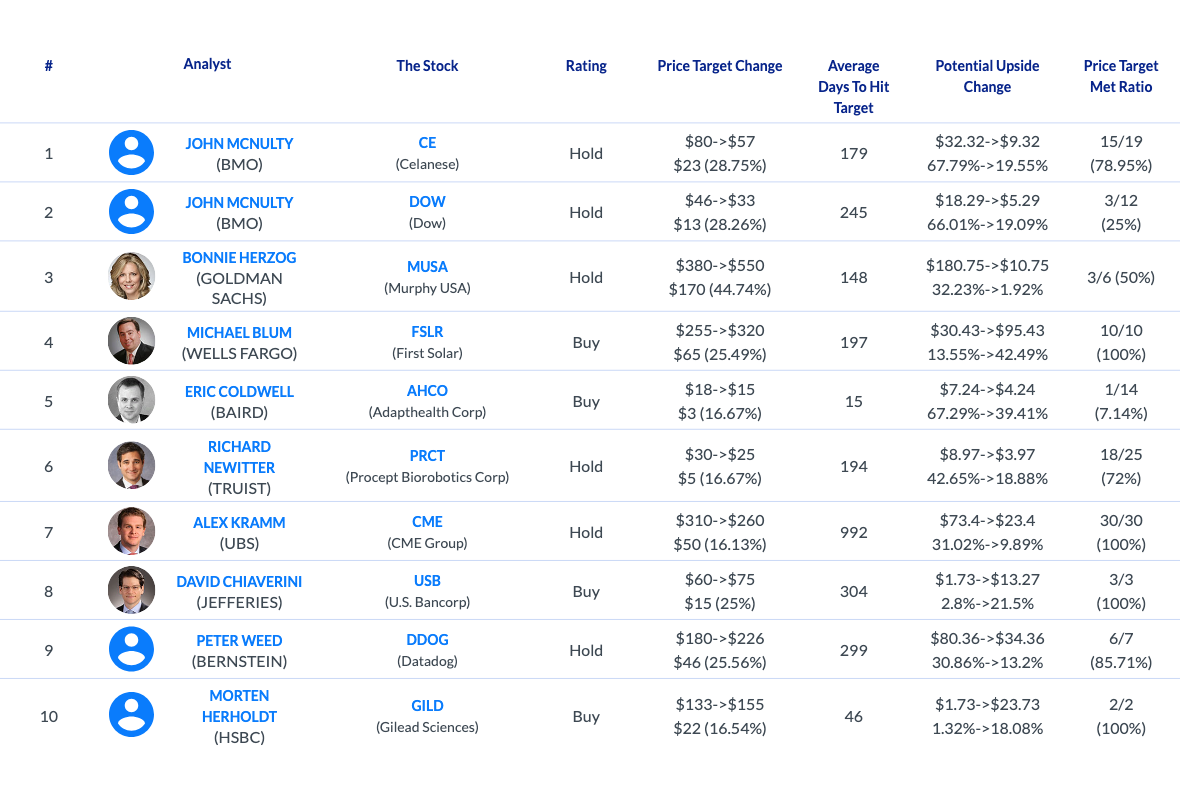
Monday’s session touched seven different research desks: Scotiabank, Guggenheim, Citi, Evercore, HSBC, Wolfe Research, and Barclays. Each brought its own number and its own reasoning. AnaChart tracks every one of those calls against what actually happens to the stock afterward. The dataset spans 661,383 price targets and 759,654 ratings from 7,191 analysts (3,754 active, 3,437 retired). It covers 9,686 tickers (6,851 listed, 2,835 delisted) at 424 brokers (333 active), going back 18 years. The full history behind today’s targets sits in AnaChart’s analyst price target dataset, for anyone who wants to check an analyst’s record before their next call.