
Selected Stock Price Target News of the Day — June 02, 2026
By Mathew Auto
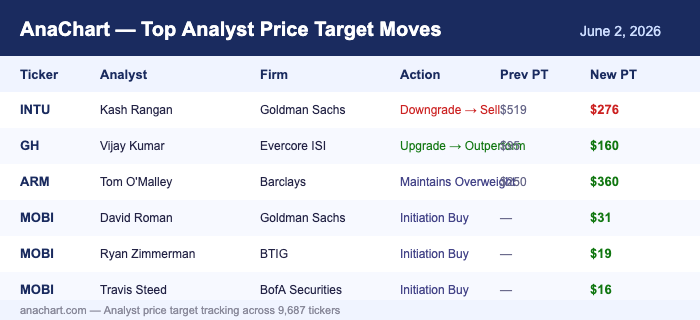
Today’s stock price target news covers three significant Wall Street calls. Goldman Sachs downgraded Intuit to Sell. Evercore ISI upgraded Guardant Health to Outperform. Barclays raised its price target on ARM Holdings by 44 percent. The moves span enterprise software, oncology diagnostics, and semiconductor design. Each action carries distinct implications for investors tracking these names in 2026.
Stock Price Target News for June 2, 2026
Tuesday’s analyst activity reflects a meaningful week for Wall Street coverage changes. Goldman Sachs made the boldest single call of the morning. The firm issued a rare Sell rating on one of the most prominent financial software companies in the world. Evercore ISI countered with a bullish upgrade in oncology diagnostics. Barclays rounded out the session with a chip-sector raise tied to a landmark company announcement. Each action is examined in detail below.
Intuit [INTU] — Goldman Sachs Downgrades to Sell, Slashes Price Target to $276
Goldman Sachs analyst Gabriela Borges downgraded Intuit from Neutral to Sell on Tuesday, June 2, 2026. The new price target is $276, down from Rangan’s prior target of $519. That cut of $243 represents a decline of approximately 47 percent in Goldman’s twelve-month outlook.
Goldman Sachs issues outright Sell ratings on large-cap technology names with notable infrequency. This move is one of the most dramatic single-analyst actions on Intuit in recent history. The downgrade signals that Goldman sees meaningful downside risk from current trading levels. In effect, Rangan’s call argues the market has priced in growth that Intuit may not deliver.
Intuit builds and operates TurboTax, QuickBooks, and Credit Karma. These three products serve tens of millions of individuals and small businesses across North America. Goldman believes Intuit’s premium software valuation multiple, historically supported by its recurring revenue model, is no longer warranted. AI-native tax and accounting tools have begun undercutting Intuit on price and ease of use.
INTU Analyst Consensus Before the Downgrade
Meanwhile, analyst consensus on Intuit had been tightening before Tuesday’s downgrade. However, Gregg Moskowitz at Mizuho lowered his target to $270 in late April. Karl Keirstead at UBS moved to $260 in mid-April. Goldman’s new $276 clusters near the low end of the Street range. That figure aligns closely with the UBS and Mizuho data. Meanwhile, Mark Murphy at JP Morgan had carried a target of $420 as recently as March 2026. The growing convergence at lower numbers signals a clear shift in sentiment ahead of Intuit’s June earnings report.
Gabriela Borges’s AnaChart track record on the name is solid. His price target met ratio across all documented recommendations stands at 69.15 percent. Overall, he achieves a potential upside of 18.89 percent within an average of 185 days. For Intuit, Rangan’s prior targets carried an average potential upside of $83.26, or 21.69 percent. Tuesday’s reversal to a Sell marks a decisive break from that bullish history on the name.
In this context, the Goldman downgrade ahead of Intuit’s June earnings print suggests Rangan expects an unfavorable narrative. Investors tracking Intuit analyst coverage can access the complete price target and rating history for INTU on AnaChart.
Guardant Health [GH] — Evercore ISI Upgrades to Outperform, Sets $160 Price Target
Evercore ISI analyst Vijay Kumar upgraded Guardant Health to Outperform on Tuesday, June 2, 2026. The new price target is $160, up from Kumar’s prior target of $95. That increase of $65 represents a gain of approximately 68 percent in Evercore’s revised view on the stock.
Separately, Guardant Health is a leader in liquid biopsy, blood-based cancer diagnostics. Its technology eliminates the need for invasive tissue sampling. The company’s Shield colorectal cancer screening test received FDA approval in 2024. Shield became the first blood-based test approved for colorectal screening in the United States. Subsequently, Guardant has been building its commercial launch across health systems and primary care networks since that approval.
The Evercore ISI upgrade signals that Vijay Kumar sees the Shield commercial ramp reaching an inflection point in 2026. Colorectal cancer is the second-leading cause of cancer death in the United States. Annual screening rates have remained below recommended levels for years. The colonoscopy requirement demands preparation, sedation, and time away from work. Shield eliminates that friction entirely. The test requires only a blood draw at a routine office visit.
The Market Case Behind the GH Upgrade
The total addressable market for colorectal cancer screening in the United States covers more than 80 million eligible adults. Even modest Shield penetration would drive material revenue growth for Guardant. Kumar set his $160 target citing expected commercial traction within twelve months. The upgrade comes as Guardant expands payer coverage and physician adoption for Shield across the country.
Guardant’s multi-cancer early detection ambitions extend beyond colorectal cancer. Additional blood-based tests are in development for other cancer types. Each future approval could expand Guardant’s platform further. Kumar’s Outperform rating at $160 reflects confidence in the core colorectal business.
Mike Polark of Wolfe Research assumed Guardant Health at Outperform with a $150 price target on Tuesday, a second bullish call on the name the same morning as the Evercore ISI upgrade.
Vijay Kumar’s AnaChart hit ratio across all documented price targets stands at 58.28 percent. He achieves an average potential upside of 14.35 percent within 145 days. Investors tracking Guardant Health analyst sentiment can access the full price target and rating history for GH on AnaChart.ARM Holdings [ARM] — Barclays Maintains Overweight, Raises Price Target to $360
Barclays analyst Tom O’Malley maintained his Overweight rating on ARM Holdings on Tuesday, June 2, 2026. O’Malley raised the price target to $360, up from his prior target of $250. The increase of $110 represents a 44 percent upward revision in Barclays‘ twelve-month view on the chip designer.
ARM Holdings licenses processor architectures used in virtually every smartphone manufactured today. Its Cortex and Neoverse designs run across mobile, server, automotive, and embedded markets. ARM does not manufacture chips itself. It earns royalty and licensing fees each time a partner ships a chip based on its intellectual property. This asset-light model generates strong margins as partner shipment volumes grow.
The Barclays price target increase coincides with a landmark ARM announcement. The company revealed that its first in-house chip design is projected to generate $15 billion in revenue by 2031. That figure represents six times the $4 billion ARM generated in fiscal year 2025. The announcement marks a strategic pivot from IP licensing toward direct silicon development. That shift would substantially expand ARM’s total addressable market. Revenue would move toward higher-margin proprietary products.
ARM Stock Reaction and Analyst Context
ARM Stock Reaction and Analyst Context
ARM stock responded sharply to the announcement. The in-house chip plan became a focus for analysts. Not every analyst agrees the reaction is warranted. Chris Caso of Wolfe Research called the combined $360 billion gain in market cap between Nvidia and ARM a significant overreaction, arguing the RTX Spark PC chip targets a market above $2,500 that represents a limited unit opportunity. “We don’t think PCs are the reason to own either NVDA or ARM,” Caso wrote. Barclays’ revised $360 target reflects the firm’s view that ARM is not yet fully priced. O’Malley also raised Barclays’ Intel target to $100 from $65 on Tuesday morning.
ARM’s Market Position and AI Exposure
ARM’s Market Position and AI Exposure
In addition, ARM’s architectural position is unique among chip companies. Its instruction set architecture runs across every major compute segment. Coverage spans cloud data centers, consumer mobile devices, automotive systems, and edge AI hardware. As AI inference workloads shift toward the edge, ARM royalty volumes should grow materially. Edge deployments occur closer to where data is generated and processed. That thesis underpins the in-house chip strategy. It also drives the bullish tone from Barclays and other firms covering the stock.
Joe Quatrochi of Wells Fargo also maintained Overweight on ARM on Tuesday and raised his price target from $255 to $410. That revision moves in the same direction as Barclays and goes further in target magnitude.
Barclays raised targets on both ARM and Intel in a single Tuesday sweep. ARM sits at the center of the demand shift, with architecture exposure across mobile, cloud, and edge simultaneously.
Which Analyst Has the Current Best Track Record on ARM?
Vijay Rakesh of Mizuho holds an 85.67 percent price target met ratio across 2,339 documented targets, the highest accuracy among the eighteen analysts covering ARM. Srini Pajjuri of RBC follows with an 85.23 percent met ratio across 383 targets. Mark Lipacis of Evercore carries an 83.95 percent met ratio across 877 tracked targets.
AnaChart tracks analyst price targets and ratings across more than 9,686 tickers. Every action covered in today’s stock price target news is in the database. Investors can access the full analyst track record for any covered stock on AnaChart. Data includes hit ratio, average upside, and days to target for each documented analyst.
The full price target history for Intuit, Guardant Health, and ARM Holdings, along with the track record of every analyst and firm named here, lives in the analyst price target dataset. It covers 661,383 price targets and 759,654 ratings from 7,191 analysts (3,754 active, 3,437 retired), across 9,686 tickers and 424 brokers (333 active), spanning 2008 to 2026.