
Selected Stock Price Target News — June 24, 2026
Six analyst actions landed on three stocks Wednesday morning. Two firms moved on Cerebras Systems ($CBRS). That came right after its first public earnings report. Two moved on Backblaze ($BLZE) after a major new contract. Two stood behind Verastem ($VSTM) after fresh trial data on a cancer drug. Different companies, different sectors, yet the result was the same. More than one analyst touched each name on the same day.
Cerebras Beats on Revenue in Its First Report, and Morgan Stanley Raises Its Target
Cerebras Systems makes an AI chip called the Wafer Scale Engine, or WSE. The chip covers an entire silicon wafer. That’s roughly 57 times the size of a conventional GPU die. Cerebras reported its first earnings as a public company Tuesday evening. That came about 18 months after its late-2024 Nasdaq IPO. Q1 2026 revenue came in at $193.4 million, up 94% from a year ago. Cloud and services revenue alone grew 167%. Core gross margin reached 47%. The net loss narrowed to $14 million, from $23.9 million in Q1 2025. On EPS, Cerebras posted a loss of $0.22 per share. Consensus had called for a $0.16 loss, so the quarter missed by six cents. Still, the revenue growth and new partnerships drew more analyst attention than that bottom-line miss.
Morgan Stanley analyst Joseph Moore initiated Cerebras coverage at Overweight on June 8. His starting target was $250. He raised that target to $273 Wednesday and kept the Overweight rating. Moore has an 80.12% hit rate across 1,643 price targets tracked on AnaChart. Needham analyst Quinn Bolton has an 84.86% hit rate across 1,499 calls. He reiterated his Buy rating and held his $300 target, though, rather than raising it. Both moves came right after the Tuesday evening earnings release.
The OpenAI Deal And The Inference Case
The Q1 report brought more than quarterly numbers. Cerebras disclosed a multi-year deal with OpenAI. It covers 750 megawatts of compute capacity, valued at more than $20 billion. That’s one of the largest single compute contracts any AI infrastructure company has disclosed. Cerebras also announced a partnership with Amazon Web Services. It brings Cerebras inference directly to the AWS platform. Enterprise customers get Cerebras speed without managing the hardware themselves. Full-year 2026 guidance calls for $855 million to $865 million in core revenue. That’s up roughly 69% from 2025.
The WSE chip is built for inference at scale. That means large models that need heavy memory bandwidth and fast token output. That use case has grown more urgent as AI shifts from training to deployment. Hyperscalers now compete on inference speed, not just raw training power. Moore’s thesis centers on one point. Cerebras is the only company with a wafer-scale chip in real commercial use, not just a lab. Bolton’s $300 target, though, puts a wider premium on that same view. The gap between the two numbers is a timing question. How fast can Cerebras’s customer base spread beyond its current cloud and government concentration?
A $335 Million CoreWeave Deal Sends Backblaze to New Highs From Citizens and Needham
Backblaze sells B2 Cloud Storage. It prices that storage at roughly one-fifth the cost of Amazon S3. Its customers are mostly neoclouds and AI companies that need large-scale storage without paying hyperscaler prices. On June 16, Backblaze signed a five-year Master Strategic Agreement with CoreWeave. The deal covers multi-exabyte storage capacity worth $335 million. It’s the largest contract in Backblaze’s history. The two analyst moves below both followed that announcement.
Citizens analyst Rustam Kanga raised his price target from $8 to $14 Wednesday. He kept a Market Outperform rating. Citizens’ institutional research runs under the JMP Securities name on AnaChart. That’s the desk that joined Citizens after a 2021 acquisition. Needham analyst Matt Dezort also raised his target, from $8.50 to $14. He kept his Buy rating. Both analysts landed at the exact same number, though, from slightly different starting points. That usually means one thing: the updated models run off the same contract math, not separate valuation work.
Two Revenue Streams From One Contract
The CoreWeave deal gives Backblaze two revenue streams from one contract. One is B2 Cloud Storage from Backblaze’s own data centers. The other is managed storage built inside CoreWeave’s facilities. CoreWeave is one of the fastest-growing AI infrastructure companies on the market. It needs large-scale storage for the GPU clusters it sells to AI labs and enterprises. So Backblaze’s low price matters here. The five-year term also gives the company revenue visibility it hasn’t had before. Annualized, the $335 million works out to $67 million a year from one customer. Backblaze’s total 2025 revenue was roughly $114 million.
Before the CoreWeave deal, Backblaze looked like a slow-growing storage business burning cash. But the contract changes that picture. If Backblaze can scale the relationship and land similar deals, the old model no longer fits. The $14 target reflects more than the $335 million alone. It also reflects proof that cost-competitive storage has a real market among GPU-heavy AI infrastructure buyers. The prior consensus target sat around $8. Both analysts moved their targets up 75%.
Fresh KRAS Trial Data Keeps HC Wainwright and BTIG at Buy on Verastem
Verastem is an oncology company. It targets RAS-pathway cancers, some of the hardest solid tumors to treat. It has one approved drug on the market: AVMAPKI FAKZYNJA CO-PACK. That drug was cleared last year for a rare form of ovarian cancer. The KRAS inhibitor discussed below, VS-7375, is different. It’s a separate, earlier-stage pipeline drug, still in trials for other cancers. In its most recent quarter, Verastem posted product revenue of $18.7 million from that approved ovarian cancer drug. Net loss for the quarter was $36.6 million, and EPS came to negative $0.46 per share. The company held $181.7 million in cash and investments as of quarter end.
Verastem drew fresh analyst attention after new data on VS-7375, its oral KRAS G12D inhibitor. KRAS mutations show up in roughly 90% of pancreatic cancers. The G12D variant accounts for about 40% of those cases. The mutation also appears in around 12% of colorectal cancers. It shows up in a smaller share of non-small cell lung cancers too. No approved therapy currently targets KRAS G12D-mutated solid tumors in any of those cancers. So that’s the gap VS-7375 aims to fill.
HC Wainwright analyst Andres Y. Maldonado reiterated his Buy rating and $18 price target Wednesday. He cited the latest interim data from the TARGET-D 101 Phase 1/2 trial. BTIG analyst Jeet Mukherjee did the same: Buy, $18 target. Neither analyst moved their number. At current trading levels, an $18 target implies roughly 300% upside. Clinical-stage biotech works that way. A drug that clears Phase 3 carries far more value than one that doesn’t. Two firms holding $18 after seeing updated data means neither was disappointed by the trial results.
The Trial Data Behind The Targets
The TARGET-D 101 readout covered more than 150 patients across dose escalation and expansion groups. One group tested 900 mg once daily in 14 pancreatic cancer patients. Of those, 93% saw more than a 50% drop in CA19-9, a tumor marker tied to disease burden. Anti-tumor activity showed up across all three target cancers: metastatic pancreatic cancer, metastatic colorectal cancer, and advanced non-small cell lung cancer. That held true both alone and combined with other drugs. The safety profile at 600 mg and 900 mg was clean. Side effects were mostly mild and gastrointestinal, with few serious events. Verastem dosed its first patient in TARGET-D 201 on June 16. That’s a Phase 2 registration-track trial in KRAS G12D pancreatic cancer.
VS-7375 works as an ON/OFF inhibitor. It blocks both the active and inactive states of the mutant KRAS protein. Existing approved KRAS drugs, like sotorasib and adagrasib, though, work differently. They target a different mutation, KRAS G12C, and only block its inactive state. Verastem’s argument is that covering both states gives more complete suppression. That could cut down on the drug resistance that has limited G12C drugs over time. Phase 3 trials across all three cancers are planned for 2027. Approval is still years away. But Maldonado and Mukherjee are both saying the early data looks like what a Phase 3 trial would need.
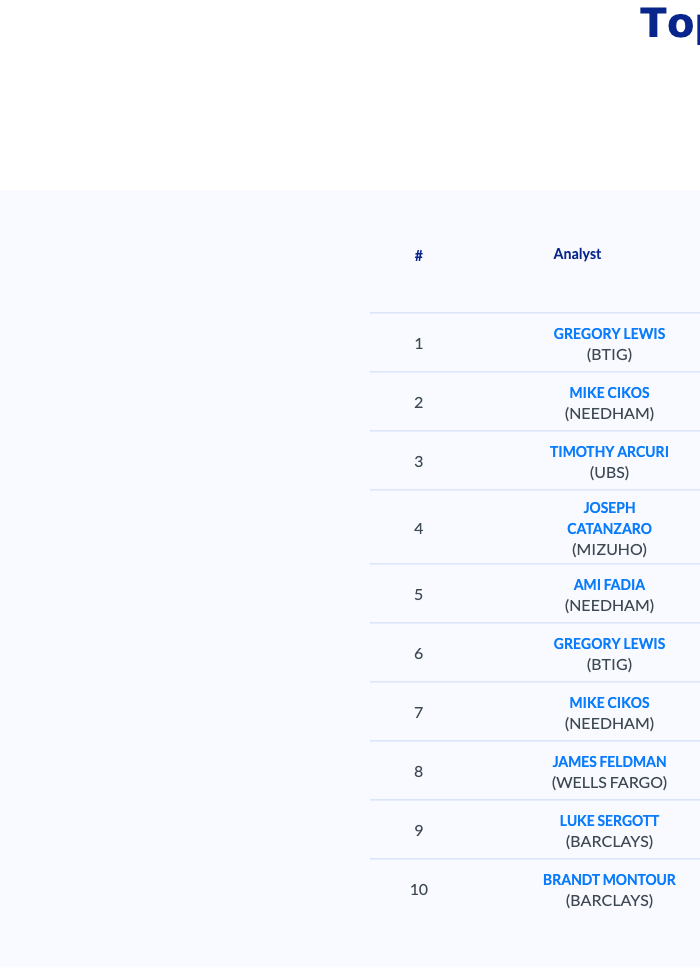
AnaChart tracks analyst accuracy across all three of these names. The dataset covers 661,383 price targets and 759,654 ratings. That’s from 7,191 analysts at 424 brokers, going back to 2008. See the full history for Morgan Stanley, Needham, HC Wainwright, BTIG, and Citizens on the analyst price target dataset page.