
Selected Stock Price Target News — June 30, 2026
Two different things moved financial stocks on June 30. The Fed was only half of it. A week earlier the central bank’s stress test had cleared every large lender. That cleared the way for dividend hikes across the sector. State Street (STT) moved first. The day’s sharpest call came from somewhere quieter. A single analyst opened fresh coverage of the whole payments and consumer-finance group that morning. He led with American Express (AXP) as a top pick. A rival desk still rates the stock a sell. Meanwhile, Capital One (COF) got caught in both stories. Here is who moved each name, why, and whose record says it matters.
Piper Sandler Opens American Express a Top Pick. BTIG Still Says Sell.
One analyst started American Express on June 30 as his single best idea in consumer finance. Another spent the same morning telling clients to sell it.
Start with what American Express actually is. It isn’t really a bank. It runs a closed loop: it issues the card, owns the network, and signs the merchant. That means it earns a fee on both ends of the same swipe. Most rivals, though, just rent rails from Visa or Mastercard. Its customers skew wealthy and business-heavy. That’s why its loan losses have stayed under the industry through every recent downturn. In its most recent quarter, American Express posted revenue of $18.9 billion, up 11% year over year, with earnings per share of $4.28. That mix throws off a strong return on equity.
The Stress Test And The New Target
Bill Carcache, opening coverage at Piper Sandler, put it at 26% a year since the financial crisis, the highest of any financial name he screened. It cleared the Fed’s stress test with its capital buffer pinned at the 2.5% floor, the regulatory minimum. Almost nothing sits between its earnings and a fatter buyback. So a buffer stuck at the floor is the friendliest read a lender can get from the test. It means the Fed found little in the book that would crack under stress. Carcache built a $396 target on that. He called it one of the cleanest compounders in the group.
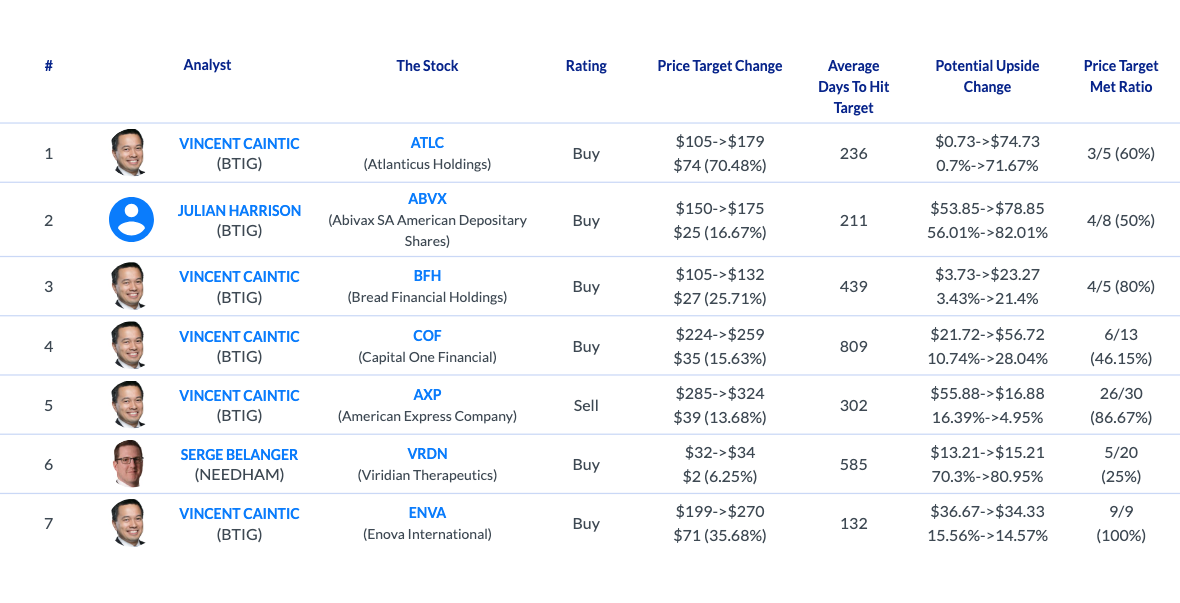
The dissent came from Vincent Caintic at BTIG. He lifted his target to $324 from $285 and would not move off his Sell. His quarrel was never the company. It was the price. At $396 against $324, Carcache and Caintic are $72 apart on the same stock. Truist had reached $375 a week earlier. The Street’s high, set back in April, still stands at $415. So Carcache is bullish without being alone out there.
So look at the records. AnaChart has Carcache hitting 81.09% of his 662 published targets. Caintic has reached 60.23% of his 595. Both cover this stock for a living, so neither number is noise. On a name where the entire fight is valuation, the more accurate forecaster is the one who just turned bullish. The Street’s average sits near $358, right between them. Now the tape gets to referee.
Capital One Gets Two Bulls in One Morning
On Capital One, though, the two desks that split over American Express suddenly agreed.
Capital One is a consumer and commercial bank. It makes most of its money lending to credit card and auto loan customers. In its most recent quarter, the company posted net income of $2.2 billion on revenue of $15.2 billion, up sharply from a year earlier after its Discover acquisition closed. That jump traces to the Discover deal. Capital One now holds the fourth U.S. card network outright, something almost no other American lender owns. Most issuers rent their rails from Visa or Mastercard. They surrender a slice of every transaction. Capital One, instead, keeps the interchange fee it used to pay away. That sits on top of the interest it already earns lending to cardholders. Only American Express, and until this deal Discover itself, ran a closed U.S. card loop; every other issuer answers to Visa or Mastercard.
The Bull Case Behind The Launch
That vertical grab is the entire bull case. It’s why Carcache folded Capital One into his coverage launch as one of five Overweights, next to Visa, Mastercard, Affirm, and American Express. The stress test only helped. Like the rest of the group, Capital One came through June 24 free to keep returning capital.
Carcache started it at $254. Minutes later, Caintic at BTIG raised his own number to $259 and held his Buy. That lands almost exactly on the $260 average across the 26 analysts who follow it. Two bulls, twelve months out, five dollars apart. The desks disagree mostly on timing, on how fast Discover’s economics show up in reported profit. That argument stretches their targets from $213 at the low to $310 at the high. Today’s two came down on the fast side.
Not one analyst AnaChart tracks rates the stock a Sell. That makes Carcache’s Overweight less a brave call than a vote for a thesis the Street had mostly swallowed already. It leaves the morning’s real curiosity with Caintic. He holds a Buy and a Sell on two card issuers at once, raised within minutes of each other. He likes the one buying its way into a network. But he will not pay up for the one that already is one.
State Street Promised a Bigger Dividend, and Five Desks Raced to Raise Targets
State Street did not report earnings or announce a deal. It, instead, promised to raise its dividend. Five firms raised their targets inside a week.
So why did a promise to pay more send five desks scrambling? State Street is a custody bank, a business most people never see. It holds, settles, and keeps the records for other institutions’ assets, $54.5 trillion of them. It manages another $5.6 trillion directly, charging fees the whole way. In its most recent quarter, State Street posted revenue of $3.8 billion, up 16% year over year, with adjusted earnings per share of $2.84. It gets paid on the size of the pile it guards. Every rally in stocks and bonds quietly lifts its fee base. It barely lends. That means it carries almost no credit risk.
Why The Stress Test Favors Custody Banks
That is exactly why custody banks glide through stress tests that punish ordinary lenders for their loan books. When the Fed cleared it on June 24, State Street said the same day it plans to lift the quarterly dividend 10%, to 92 cents from 84. Its capital buffer held at the same regulatory floor into 2027. For a fee machine with no capital fight in front of it, a bigger payout is management telling you it likes what it sees. The desks read it the same way.
The raises came in a stack. Goldman Sachs went to $194 on June 30. Betsy Graseck at Morgan Stanley had reached $183 the day before. Truist hit $176 the week prior. Wells Fargo set a Street-high $196. Citigroup went to $193. Five desks, all between $176 and $196, all clustered around the dividend news.
A Repricing, Not A Bet
When five firms land within twenty dollars of each other, that is a repricing, not a bet. The strange part is where AnaChart’s own average still reads: about $152 across 17 analysts, because the data has not swallowed this week’s raises yet. Graseck, whose targets have come through 74.59% of the time, sits at the bottom of the new range. She is still roughly $30 above that stale consensus. Give it a few days and the average catches up to the desks. The analysts always move first.
The seven desks here, Piper Sandler, BTIG, Morgan Stanley, Goldman Sachs, Wells Fargo, Citigroup, and Truist, are a thin slice of the 424 brokers AnaChart tracks. Behind them sit 661,383 price targets and 759,654 ratings from 7,191 analysts across 9,686 tickers, eighteen years deep, each call stored with its source and its hit rate. The complete analyst price target dataset is available to download.