McDonald's Price Target Cut, September 24 2026
McDonald’s (MCD)
McDonald’s price target news led Thursday’s session, after two analysts moved on the stock. The chain operates and franchises more than 43,000 fast-food restaurants worldwide. About 95% of those locations are run by franchisees, not the company itself. Franchise royalties and rent make up most of its revenue, not the burgers themselves. The company’s market cap sits near $182 billion. That makes it one of the largest names in the restaurant group AnaChart tracks. It topped second-quarter estimates on August 4. Adjusted EPS came in at $3.38 against a $3.34 consensus, a four-cent beat. Revenue landed at $7.1 billion, just under the $7.14 billion analysts expected.
Profit beat the plan. Sales missed it by a touch. That split points to a chain leaning on cost discipline and value promotions. A Bloomberg report out Wednesday said the company called August’s U.S. business “slightly negative.” That is a rare admission for a chain built on value-menu traffic. The report flagged lower-income diners pulling back on visits. That is the group McDonald’s value platform targets most directly.
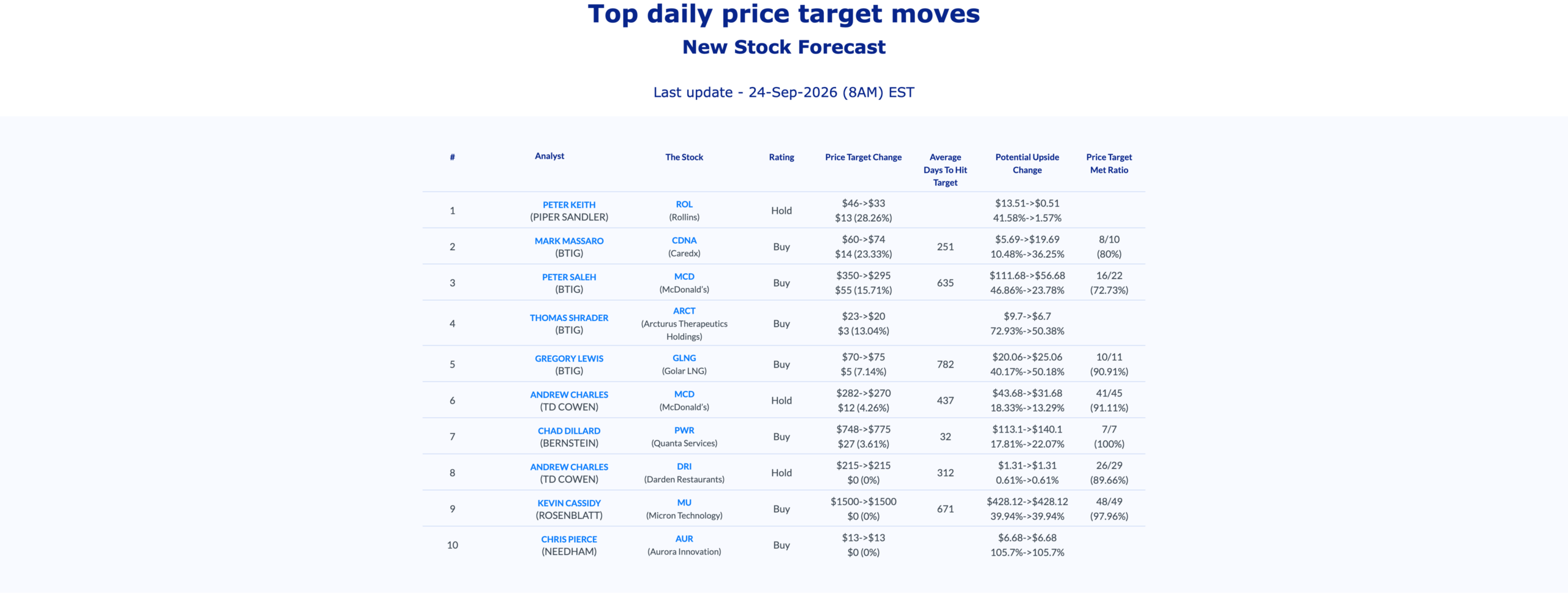
The company’s global loyalty program has grown alongside that push. It now counts nearly 220 million active members across 70 markets, a 13% increase from a year earlier. Systemwide sales to those members topped $40 billion over the past twelve months. Management is also targeting 50,000 restaurants worldwide by the end of 2027, its fastest expansion pace on record. Two analysts cut their price targets on McDonald’s Thursday in response to the soft U.S. update. Peter Saleh of BTIG maintained his Buy rating. He lowered the price target from $350 to $295 today. Andrew Charles of TD Cowen maintained his Hold rating. He lowered the price target from $282 to $270 today.
McDonald’s price target: the track record behind today’s calls
Saleh’s prior call on MCD was met 16 of 22 times, a 72.73% hit rate. The average time to hit was 635 days, per AnaChart’s database. Across his full 31-stock restaurant and consumer coverage list, he converts calls at 72.77%. Charles’s last 45 McDonald’s calls hit 41 times, a 91.11% rate. His broader 21-stock coverage book converts at 74.33%. Saleh’s new $295 target implies more than 20% upside from current levels.
Praxis Precision Medicines (PRAX)
Praxis is a clinical-stage biotech company. Its work centers on brain and nerve disorders. Its top programs target rare, gene-linked forms of epilepsy and essential tremor. The company carries a market cap near $9.6 billion. It has no approved drug yet.
The company recently filed new drug applications for two lead drugs. One is ulixacaltamide, for essential tremor. It blocks T-type calcium channels in the brain circuit that drives tremor. That is a different mechanism than older drugs like propranolol. The other is relutrigine, for a rare form of childhood epilepsy. It targets sodium-channel mutations tied to two severe genetic syndromes, SCN2A and SCN8A, that surface in infancy.
Its second-quarter report, filed August 6, put a number on that stage. Praxis reported an EPS loss of $2.87 per share, on a net loss of $83.7 million for the quarter. It closed the quarter holding $1.4 billion in cash and other investments. By the company’s own account, that is enough to fund its work into 2028.
Praxis drew reiterations from two of its longtime bulls Thursday. Neither analyst moved a price target. Douglas Tsao of HC Wainwright & Co. reiterated his Buy rating. He kept his price target at $1,201 today. Ami Fadia of Needham reiterated her Buy rating too. She kept hers at $582 today. The gap between those two numbers runs nearly $620.
Praxis: the track record behind today’s calls
Tsao’s price-target record across his full 53-stock healthcare coverage book sits at 47.55% of calls met. Fadia’s last 17 targets on Praxis landed 13 times, a 76.47% hit rate, built over more than two years of covering the name. Her $582 target sits far below Tsao’s $1,201. That gap has held for months.
Quanta Services (PWR)
Quanta operates crews that build and fix the power grid and telecom lines. It works through two main segments, electric power and underground utility work. That covers power lines, substations, wind and solar hookups, and telecom networks. Most of that work runs under long-term deals with utilities. The company employs more than 69,500 people. Its market cap sits near $98 billion, among the larger names in AnaChart’s industrials coverage. On July 30 it posted adjusted EPS of $4.24 against a $3.29 consensus, a 95-cent beat. Revenue came in at $9.56 billion versus $8.61 billion expected.
Quanta carried a record $53 billion backlog into the back half of the year. That backlog is a multi-year revenue book already under contract, not a forecast. Data center power demand is a growing piece of it. Quanta crews build the substations and transmission upgrades that feed new AI data centers. That work sits alongside the grid-modernization projects utilities have been ordering for years. Fixed-price contracts accounted for roughly 63% of Quanta’s first-quarter revenue this year, a shift toward larger, higher-margin work.
Management raised full-year 2026 revenue guidance to a range of $39.3 billion to $39.7 billion on the strength of it. Quanta got the day’s clearest upgrade Thursday. Chad Dillard of Bernstein moved Quanta Services from Market Perform to Outperform. He raised the price target from $748 to $775 today, calling the stock a top pick in the group.
Quanta: the track record behind today’s call
Seven of Dillard’s last seven calls on Quanta were met, a 100% hit rate, with an average conversion window of 32 days. His broader 21-stock industrials and technology coverage book converts at 96.81%.
Every price target above is scored the same way, across more than 9,600 tickers, reached or not reached. The full file, updated daily, is available for download at the AnaChart store, alongside the underlying ratings history for every analyst named above. Each figure comes from the analyst’s own published note. AnaChart matches it against its own record of whether that call was eventually met, ticker by ticker, analyst by analyst.