
Patterns Behind Analyst Price Target Changes
By: Michael Muchugia
Each year, Wall Street analysts issue thousands of price target updates. To most investors, these changes look like isolated reactions to earnings, headlines, or price movement.
But when measured systematically, revisions follow repeatable behavior patterns—and those patterns determine whether a price target change contains a signal or simply mirrors the market.
This piece breaks down five common revision behaviors and what they tend to predict:
- Small vs. large target adjustments
- Clustered revisions
- Sector-specific revision behavior
- Reaction vs. anticipation revisions
- Lagging revisions
The goal is not to collect targets—but to understand what the way analysts revise reveals about conviction, timing, and predictive value.
The Core Insight: Behavior > Opinion
A price target is an output. The revision pattern is the input.
Two analysts can arrive at similar targets while behaving very differently:
- One revises early, decisively, and infrequently
- Another revises often, incrementally, and after the move
The difference is not in the number—it’s in the behavior.
So the better question becomes:
What does this revision pattern reveal—and what does it predict?
With that framing, each pattern can be evaluated on its behavioral logic.
1) Small vs. Large Adjustments: Calibration vs. Conviction
Small price target adjustments often reflect calibration—analysts updating models without changing their core thesis.
Large adjustments signal conviction shifts, where the analyst is effectively re-underwriting the story.
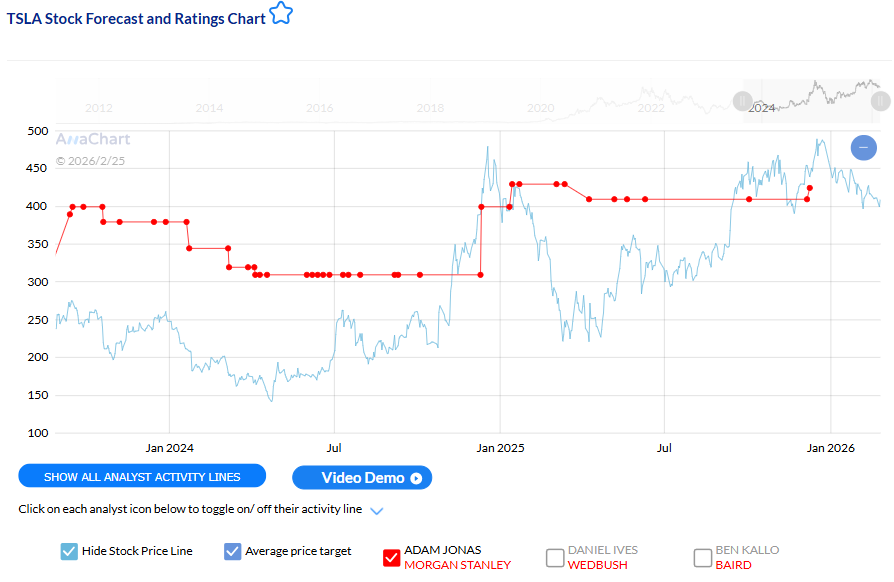
A clear example comes from Adam Jonas (Morgan Stanley) on Tesla (TSLA). During periods of demand uncertainty in early 2024, Jonas issued multiple step-change reductions to his price target rather than incremental adjustments.
These revisions were not simple model updates. Each change coincided with a shift in narrative—from growth durability to demand normalization and margin compression.
The distinction is visible in the magnitude and timing:
- Targets were revised after reassessing long-term delivery expectations, not short-term price movement
- Each adjustment required a reframing of the investment thesis, not just recalibration
This is the key signal: when a revision forces the analyst to re-explain the story, it reflects a shift in conviction—not model maintenance.
2) Clustered Revisions: When Analysts Move Together
Clusters occur when multiple analysts revise targets within a short window.
This is common in heavily covered stocks like NVIDIA (NVDA), particularly around earnings or major guidance updates.
A recognizable cluster typically looks like:
- Several analysts updating targets within 24–72 hours
- Ratings remaining consistent (e.g., Buy stays Buy)
- A shared narrative emerging (AI demand, data center growth, etc.)
For example, analysts such as Vivek Arya (BofA) and Stacy Rasgon (Bernstein) often revise targets in close proximity following NVDA earnings, forming tight revision clusters.
However, the presence of a cluster alone is not sufficient.
Clusters that form just before earnings or major catalysts often precede continued momentum, as analysts position ahead of new information.
By contrast, clusters that emerge immediately after a strong price move tend to coincide with consolidation phases, where targets adjust to reflect what has already occurred rather than what comes next.
Clusters don’t create signals—timing within the cluster does.
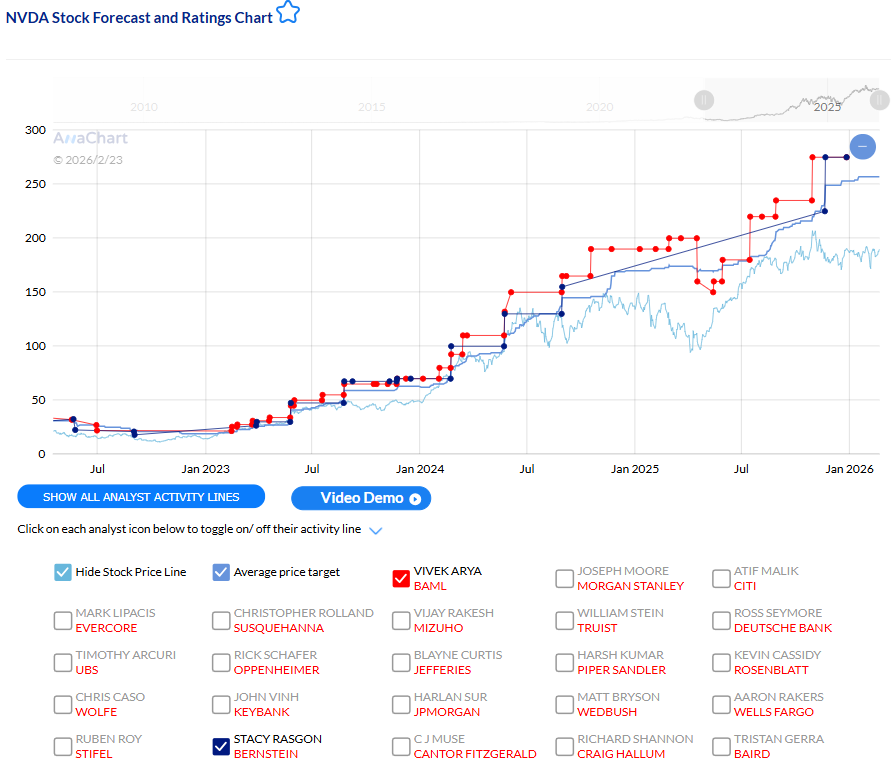
Figure: Analyst Revision Clusters in NVIDIA (NVDA)
Clusters of revisions become visible during the 2023–2025 period, with multiple analysts updating targets within tight time windows.
The key pattern is sequencing. In most cases, price moves occur first, followed by clustered target revisions within 24–72 hours. Analysts then adjust targets upward in increments as expectations are recalibrated.
This indicates confirmation behavior rather than anticipation—targets are aligning with price action, not leading it.
3) Sector-Specific Revision Behavior: Context Matters
Revision behavior is not uniform across sectors.
In high-growth technology sectors, analysts revise targets more frequently due to:
- Rapid changes in expectations
- Evolving market opportunity estimates
- Narrative-driven valuation shifts
For instance, analysts like Brent Thill (Jefferies) frequently revise targets across SaaS companies, often multiple times within a single quarter. This reflects the rate of change in forward expectations, not necessarily an increase in predictive signal.
In contrast, similar revision frequency in a more stable sector would represent a deviation from normal behavior—and therefore a stronger signal.
The key interpretation rule:
Before evaluating the revision, evaluate the context in which it occurs.
4) Reaction vs. Anticipation: Who Is Leading?
This is where the strongest signals emerge.
Anticipatory analysts:
- Revise before major price movements
- Position ahead of earnings or structural inflection point
Reactive analysts:
- Revise after the stock has already moved
- Adjust targets to align with current price action
In Netflix (NFLX) coverage, the distinction between anticipatory and reactive behavior becomes clear when examining the sequence of revisions.
During mid-2024 momentum phases, analysts such as Doug Anmuth (JPMorgan) consistently raised price targets during sustained upward price trends, often without a corresponding change in rating.
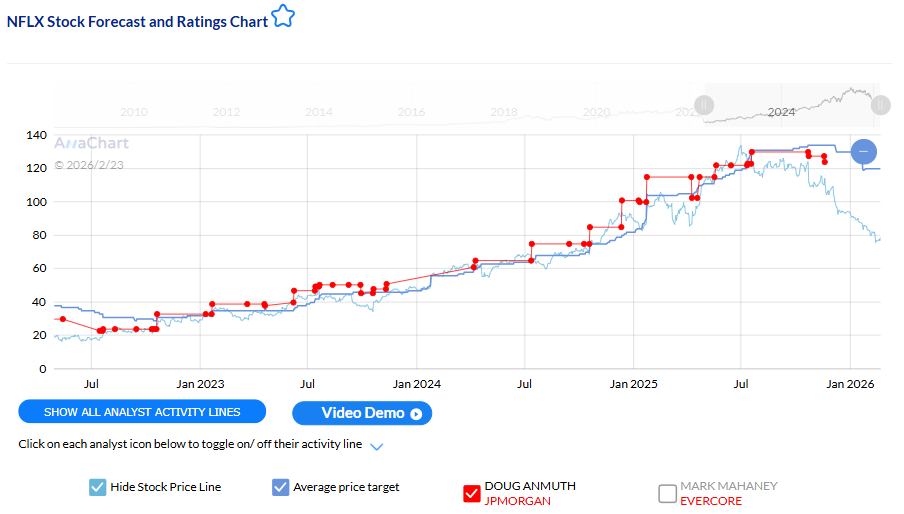
This creates a recognizable sequence:
- Price moves first
- Targets follow
In these cases, the revision reflects alignment with market movement rather than forward positioning.
A simple test:
If the stock has already moved, the revision is likely explaining, not predicting.
5) Lagging Revisions: The Illusion of Insight
Lagging revisions go a step further than reactive behavior.
Reactive revisions follow price movement relatively quickly.
Lagging revisions occur well after the move is established.
This often appears as:
- Price targets that remain below the current stock price for weeks after a rally
- Late upgrades after prolonged upward trends
- Delayed downgrades after sustained declines
These revisions create the appearance of active coverage, but the timing significantly reduces their predictive value.
While the analyst may be updating their view, the market has already incorporated the underlying information.
The Behavioral Hierarchy: Which Revisions Matter Most
When viewed together, revision behaviors form a clear hierarchy:
| Revision Behavior | Predictive Value | Why |
| Anticipatory revisions | High | Occur before price movement, reflecting forward positioning |
| Early clustered revisions | High | Indicate emerging consensus ahead of broader market recognition |
| Large conviction-driven changes | Medium–High | Signal thesis-level shifts, but not always early |
| Small incremental adjustments | Low | Reflect model maintenance rather than new insight |
| Lagging revisions | Very Low | Occur after information is already priced in |
The implication is clear:
Predictive value is driven by timing and conviction—not frequency of updates.
What This Means for Investors
Price targets should not be taken at face value.
Instead, evaluate:
- Timing → before or after the move
- Magnitude → minor adjustment or thesis shift
- Clustering → isolated revision or consensus move
- Context → normal behavior or unusual activity
This allows investors to distinguish between:
- Signal → forward-looking insight
- Noise → reactive recalibration
Conclusion
Analyst price target changes are often treated as isolated updates. In reality, they follow structured behavioral patterns that repeat across stocks and market cycles.
Understanding these patterns transforms how revisions are interpreted.
Because the real question is not:
What did the analyst change the target to?
But:
What does how they changed it reveal about their conviction—and what does that behavior tend to predict next?
Ultimately, in markets driven by expectations, the timing of a revision often matters more than the revision itself.
🔍 See Real Analyst Track Records on AnaChart
AnaChart tracks 4,000+ Wall Street analysts — see their price target history, accuracy rate, and performance score for any stock.
Patterns Behind Price Target Changes: FAQ
What patterns drive analyst price-target changes?
Most changes follow earnings, guidance revisions, M&A, product news, or shifts in valuation multiples. Across many analysts, recognizable patterns emerge — some revise in small, frequent steps, others in large, infrequent jumps.
Are frequent price-target revisions a good or bad sign?
Neither by itself. What matters is whether the revisions have historically been right. AnaChart scores each analyst’s targets by whether they were actually met, so you can tell disciplined revisers from those who simply chase the price.
Where can I study an analyst’s revision pattern?
On a stock’s AnaChart page, each analyst’s targets are plotted over time against the share price, revealing their revision rhythm and how it lined up with events.
Related on AnaChart: browse the top performing analysts by sector, and compare platforms in AnaChart vs TipRanks.
For institutional teams: AnaChart’s full analyst price-target and accuracy dataset — every analyst, every target and revision since 2004 — is available warehouse-native through AnaChart Corporate Access, delivered straight into Snowflake or Google BigQuery with no ETL.