
Right Too Late Is Wrong: The Case for Measuring Analyst Timing
Right Too Late Is Wrong: The Case for Measuring Analyst Timing
In the financial world, people speak reverently about “accuracy,” as if a price target that eventually hits is some badge of intellectual triumph. But reality does not wait politely for delayed insight to catch up. In markets — as in all human action — timing is not an accessory to truth; it is part of the truth itself.
A prediction that materializes in forty days possesses an entirely different nature from one that materializes in four hundred. One requires comprehension; the other, coincidence. Yet most platforms flatten these distinctions, treating late correctness as equal to early insight.
AnaChart rejects that evasion. We measure analysts not only by whether they were right, but by how long the truth waited for them. This is the principle of Time to Materialize, and it exposes the difference between genuine foresight and accidental luck.
Part I — The Temporal Signature of a Stock
Every stock carries its own internal logic — its own pace, its own cycle, its own resistance to guesswork. Some names respond swiftly to catalysts; others move like slow tectonic plates beneath the surface of the market. To pretend that one can judge an analyst without first judging the nature of the stock is to dismiss the chain of causation that markets obey.
Moderna (MRNA) is an ideal proving ground for this truth.
Part II — MRNA: A Stock That Exposes the Illusion of Timeless Accuracy
Moderna’s history is not a straight line but a sequence of distinct eras — each governed by different facts, different catalysts, and therefore different reasonable expectations.
- Pre-COVID: A quiet biotech governed by clinical timelines.
- COVID explosion: A historic acceleration of demand and volatility.
- Post-COVID normalization: A rational slowing as markets reassessed valuations.
- Pipeline repricing: A deliberate contraction informed by long-term uncertainty.
The same price target means something radically different depending on when it was issued. A 100% accurate analyst during COVID could be disastrously late during post-COVID contraction. A slow, plodding analyst might accidentally appear visionary during momentum-driven surges. To measure accuracy without time is to measure a shadow and call it substance.
Part II-A — A Counterexample: IIIV and the Slow March of Market Realization
If Moderna revealed the rapid volatility of a catalyst-driven biotech, then i3 Verticals (IIIV) stands as its opposite: a company whose forecasts materialize only through the long, patient grind of fundamentals. Here, time is not an accessory to analysis — it is the crucible in which genuine understanding is separated from casual speculation.
IIIV’s timing profile exposes a different law of motion:
- Average Days for Price Targets to Materialize: ~230.63 days
- Price-Targets Met Ratio: ~82.24%
Nearly eight months — that is the typical waiting period between an analyst’s forecast and the market’s recognition of it. In such a stock, a rapid materialization is not a triumph but an anomaly. The investor who demands immediate validation will be punished; the investor who respects the causal structure of the business will see the truth reveal itself at its own, deliberate pace.
This stands in complete contrast to MRNA’s accelerated lifecycle. Where Moderna could vindicate or invalidate a forecast in a matter of weeks, IIIV moves with the gravity of a slow-turning planet. Yet the principle remains unchanged: the value of an analyst’s prediction cannot be severed from the timeline in which the stock permits it to be realized.
To judge analysts without judging the stock is to pretend that all companies respond uniformly to insight. They do not. IIIV proves this relentlessly. Slow-cycle stocks expose analysts who rely on momentum rather than comprehension; meanwhile, they reward only those whose convictions can withstand the test of time.
Part II-B — One Analyst Inside a Slow-Moving Stock: Mark Palmer’s Long Horizon
If IIIV reveals the cadence of a slow-materializing stock, then Mark Palmer of Benchmark represents the analyst shaped by that cadence. His coverage history, extending from 2018 through 2025, shows a pattern that is not impulsive, not captive to the market’s latest tremor, but tethered to a long-range understanding of business fundamentals.
Across his repeated forecasts — $27, $31, $36, $33, $42, back to $31, then rising again into the mid-30s — the through-line is unmistakable: a model of valuation that expects truth to surface gradually, through operational compounding rather than dramatic revelation.
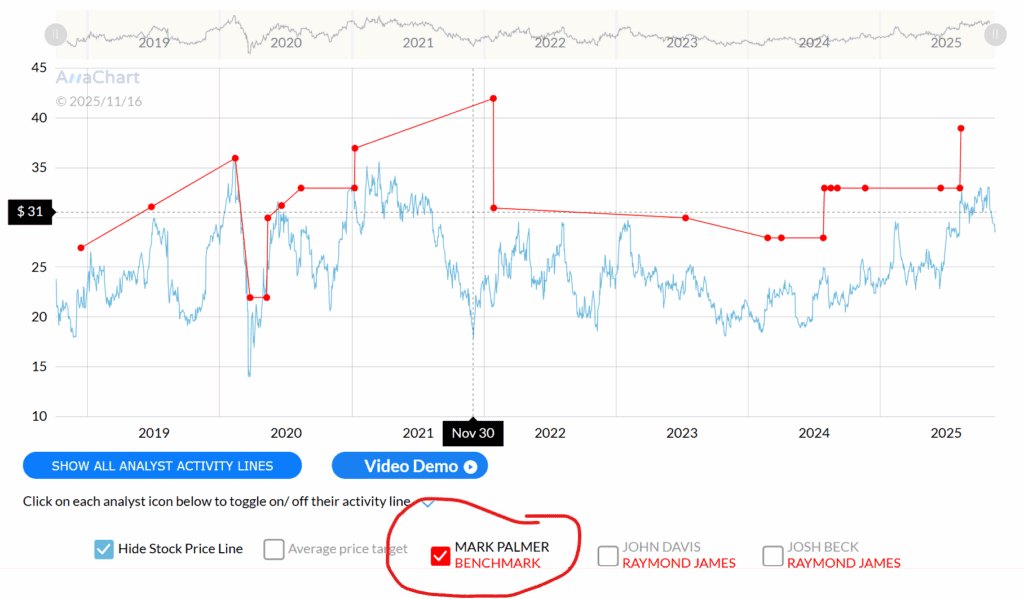
Palmer’s targets typically sit only 1.15× to 1.50× above the prevailing share price, rarely drifting into the distortions that characterize momentum-driven names. They express an important principle: in companies like IIIV, value is harvested through time, not spectacle. When his targets are met, they are not met in a week nor a month; they mature like a long-planned construction project — slowly, predictably, with cause preceding effect.
Contrasted with a rapid-cycle stock like Moderna, where analysts must function within compressed timeframes, Palmer’s method demonstrates the opposite virtue: the courage to be patient. To follow such an analyst is to reject the counterfeit urgency of the market’s daily noise and to align instead with the deeper tempo of a business that rewards endurance over immediacy.
Part III — Matthew Harrison (Morgan Stanley): Time, Truth, and Market Cycles
Among the analysts covering Moderna, Matthew Harrison stands out not because he is flawless, but because his long record lays bare the connection between timing and comprehension.
His price targets trace a vivid arc:
- From $29 in 2019, in the quiet before the storm,
- to $337 in 2021 during the vaccine-era surge,
- down through $209 → $153 → $128 → $115,
- and finally to $89 → $70 → $38 as long-term realities reasserted themselves.
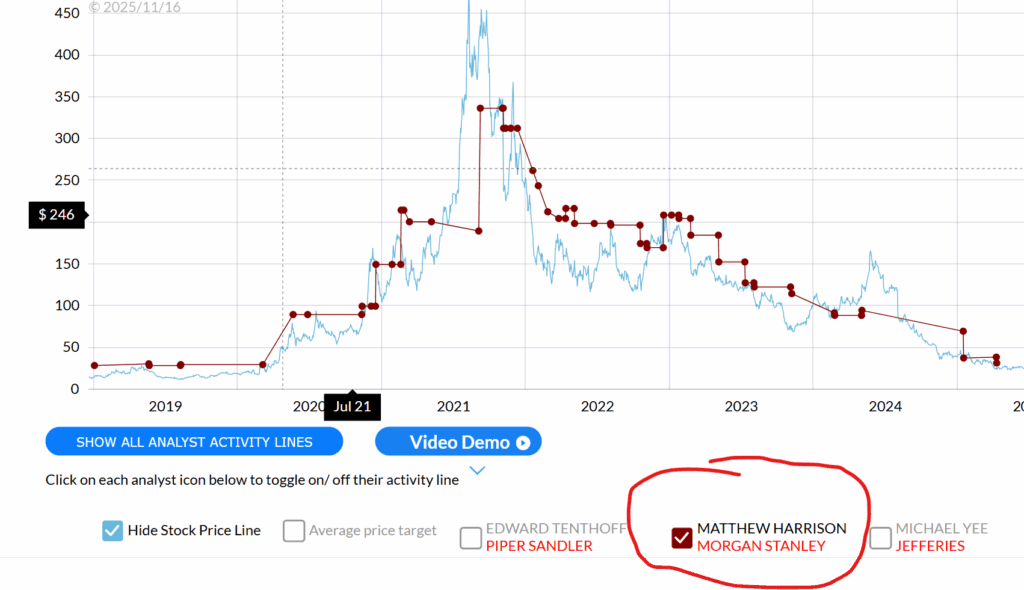
Timing reveals whether an analyst is responding to reality — or chasing it.
When the world moved swiftly, Harrison’s calls materialized swiftly. When the world slowed, so did his accuracy. The analyst changed less than the stock did — and the contrast exposes the true engine of time to materialize: the relationship between an individual mind and the unfolding facts.
Part IV — The Investor’s Responsibility: Judge by Reality, Not Retrospect
Investors are often trained to look backward and ask the passive questions: “Did the analyst get it right?” or “Did the target hit?” These questions forgive lateness, indecision, and accidental correctness. They ignore the actual nature of skill.
AnaChart insists on the active questions:
- How long did it take?
- Is the analyst consistently timely on this stock?
- Do they grasp not only the destination — but the speed?
A correct prediction issued too late is not a prediction — it is a chronicle. It serves no investor who must allocate finite capital under uncertainty.
Only when we measure both accuracy and time does an analyst’s true character emerge.
Final Principle — Timing Is Not Optional
There is a moral premise beneath this analysis: reality is not impressed by delayed understanding. An analyst who requires half a year to recognize what the market will realize next week is not offering insight; he is offering commentary wearing the mask of knowledge.
But an analyst who repeatedly anticipates the future before it becomes obvious is demonstrating something rare: the independent judgment of an active, rational mind. This is the essence of what AnaChart measures — not merely who was right, but who was right in time.
The market rewards those who grasp reality when it matters. AnaChart reveals who those people are.
To go deeper into timing, accuracy, and analyst consistency, explore the AnaChart dataset and see which analysts demonstrate real foresight — and which follow the market they claim to lead.
Related Reading
- What Makes an Analyst Consistently Accurate?
- Contrarian Analysts Who Beat Consensus
- Why Analyst Rating Revisions Matter
🔍 See Real Analyst Track Records on AnaChart
AnaChart tracks 4,000+ Wall Street analysts — see their price target history, accuracy rate, and performance score for any stock.
Explore AnaChart Free →Measuring Analyst Timing: FAQ
Why does the timing of an analyst’s call matter?
A target that is eventually reached but only after a long delay, or after the move already happened, has little practical value. Measuring timing separates analysts who are early and right from those who are merely right too late.
How does AnaChart account for timing?
AnaChart records the average days for an analyst’s targets to be met and folds speed into its performance score, so a bold target reached quickly outscores a cautious one that took years.
Where can I see how quickly an analyst’s targets are hit?
Each analyst’s record on a stock’s AnaChart page includes average days to target alongside the met ratio, so you can judge timing directly.
Related on AnaChart: browse the top performing analysts by sector, and compare platforms in AnaChart vs TipRanks.
For institutional teams: AnaChart’s full analyst price-target and accuracy dataset — every analyst, every target and revision since 2004 — is available warehouse-native through AnaChart Corporate Access, delivered straight into Snowflake or Google BigQuery with no ETL.