
Why the Analyst's Name Matters More Than the Firm
The analyst’s name behind a price target is the one detail most platforms quietly drop. On June 23, 2026, the headline read: “Wolfe Research upgrades Target.” Clean, authoritative, done. Except Wolfe Research is a firm with hundreds of people in it, and not one of them is named “Wolfe Research.” A specific person sat down, built a model, and put their name on a $162 target for Target (TGT). The headline left that person out. Most platforms do.
That missing name is the whole story. A price target is a personal call, made by an individual with a track record you can check. Strip the name and attach the call to a logo, and you have thrown away the one thing that tells you whether to trust it. The firm did not stay up late stress-testing Target’s margins. A named human did, and that human has a record of targets reached, and missed, before. It is the same everywhere a name carries the work. A wine is sold under the winery’s label, but a specific winemaker made the calls behind that vintage, and it is their reputation, not the estate’s, that rises or falls with it. A battle is remembered as the army’s, yet a named general made the decisions and owns the win or the loss. A price target is no different: the firm is the label, the analyst is the one exposed.
The firm is a nameplate. The call is a person.
Look at how a typical research aggregator presents Target. Fintel’s rating table has a column headed “Analyst,” and every row under it lists a firm: Jefferies, Wolfe Research, Guggenheim, Goldman Sachs, Telsey, Baird. The people are gone. The site’s own news items say things like “Wolfe Research Upgrades Target” and “Freedom Broker Downgrades Target,” as if the building formed an opinion.
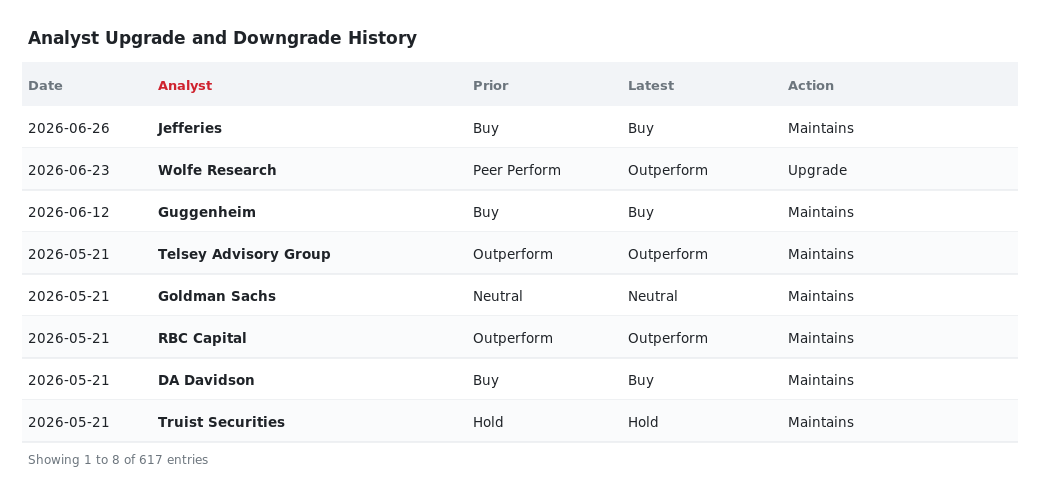
It didn’t. Here is who holds that Target coverage, by name, and how their past targets have played out:
| The firm-level headline | The analyst who made the call | Target | Price targets reached |
|---|---|---|---|
| “Wolfe upgrades Target” (Jun 23) | Spencer Hanus, Wolfe | $162 | 0 of 3 (0%) |
| “Jefferies maintains Buy” | Corey Tarlowe, Jefferies | $161 | 3 of 14 (21%) |
| “Guggenheim stays Buy” | John Heinbockel, Guggenheim | $145 | 4 of 5 (80%) |
| “Truist holds” | Scot Ciccarelli, Truist | $130 | 19 of 27 (70%) |
| “Baird holds” | Peter Benedict, Baird | $135 | 33 of 45 (73%) |

Same five headlines. Wildly different information once the name is attached. A $162 target from an analyst whose Target calls have been reached zero times out of three is not the same input as a $145 target from one who has reached four out of five. Read the firm names alone and both just say “a bank likes Target.” Read the analyst names and their records, and you can tell them apart. The name is what does the sorting, and the sorting is the entire point of reading analyst research in the first place.
Analysts are individuals, and individuals move
Here is the part firm-level tracking quietly breaks. Analysts change jobs. They get recruited, promoted, poached, and re-shuffled across desks, and they take their coverage and their skill with them. “Wolfe’s Target analyst” is not a fixed person. It’s a chair, and different people sit in it over the years.
So when you follow the firm, you are following whoever happens to hold the seat this quarter, with a track record that silently blends everyone who held it before. The analyst who built a genuinely strong record on a stock at one shop shows up next year under a different logo, and the firm-level view treats them as a stranger. The record resets to zero. Meanwhile the firm’s nameplate keeps its history even though the person behind it changed. You end up crediting the building for work the building never did, and starting a proven analyst back at square one the moment they switch business cards.
Follow the person instead and none of that happens. The record belongs to the analyst. It travels with them from firm to firm, so a good call three years ago at one bank still counts when they make a new call today at another. AnaChart tracks 7,191 analysts across 424 brokers precisely so the history stays attached to the human who earned it, not the letterhead they happened to be under at the time.
What the name lets you do
Target is covered by 28 analysts right now, with an average price target of $131.51 and a group met ratio of about 59%. That average is the blur. It hides the fact that some of those 28 reach their targets most of the time and some almost never. Averaging them together, or worse, collapsing them into a handful of firm logos, throws away the only distinction that matters when you are weighing a fresh $162 versus a fresh $145.
With the name attached, each target carries its own author and its own receipt: how often that analyst’s past targets on this stock were reached, their average projected upside, and how long their targets have historically taken to hit. You stop reading “the Street thinks X” and start reading “this specific person, who has been reached N times out of M, thinks X.” One is noise. The other is something you can weigh, size, and act on.
How AnaChart handles it
Every one of AnaChart’s 661,383 price targets and 759,654 ratings is booked to a named analyst, never to a bare firm. Open any stock and you see the individuals covering it, each with a met ratio, an average upside, an average days-to-hit, and a performance score built only from that analyst’s own history. Open an analyst’s profile and you see their full record, carried across every firm they have worked at. When they switch jobs, the history follows them, because the history was always theirs. Take Kate McShane, who covered many of these same retail names at Citi before moving to Goldman Sachs: AnaChart holds every price target she has issued across both firms as one continuous record under her name, 1,510 price targets and ratings on 64 stocks at a 74.94% met ratio, so changing employers never resets what she has built.
The firm still tells you something. It signals resources, distribution, and reputation. But it does not make the call, and it does not hit or miss the target. A person does. If a platform can only tell you which bank had an opinion, it is answering a less useful question than the one you asked.
Common questions
Do analysts really change firms that often?
Often enough that firm-level records are unreliable over any real time horizon. Across AnaChart’s 424 tracked brokers, a large share of the 7,191 analysts appear under more than one firm over their careers. Tie the record to the firm and you are averaging across whoever passed through the seat.
Why do most platforms show the firm instead of the analyst?
Firm-level data is easier to source and cheaper to maintain. Fintel’s Target page, for example, lists 617 rating changes under a column headed “Analyst,” yet every row shows a firm. Naming the person means matching every target to a specific individual and keeping that link intact as they move, which is more work, and exactly why the platforms that skip it leave you with less.
Does the firm matter at all, then?
It matters as context, not as the unit of accountability. A firm’s brand can move a stock on announcement day. But when you are grading whether a target tends to be reached, the individual is the thing to track: on Target, John Heinbockel’s past targets have been reached 4 of 5 times (80%) while another covering analyst sits at 0 of 3, and the firm label alone would never tell you which is which.
How do I find who set a specific target?
On AnaChart, open the stock and read the analyst table directly. Each price target lists the analyst by name and links to their full cross-firm track record, so “Wolfe upgraded Target” becomes “Spencer Hanus set a $162 target, and here is how his past Target calls have done.”
Analysts are people. Their calls are personal, their skill is portable, and their record is the receipt. Track the name, and you can tell a sharp call from a loud one. Explore the full analyst price target dataset, then open a stock and check who set the number before you weigh it.
More from AnaChart Research: Analyst price targets follow the stock, they don’t lead it (82.6% of 426,782 revisions move the way the stock already went) and Wall Street analyst turnover (median career 7.3 years, only 44.9% still covering after ten).