
Analyst Price Target News: Week of February 26th, 2026
This week, analyst activity was driven by earnings releases across enterprise software, consumer discretionary, and home improvement. Workday’s disappointing FY2027 guidance triggered a broad wave of analyst price target cuts, while results from consumer names prompted mixed revisions across the sector.
By: Michael Muchugia
Written by Michael Muchugia. Edited later by Mathew Auto, AnaChart research desk. Updated November 1, 2026 with what happened next.
Workday Guidance Miss Triggers Broad Analyst Reset
The WDAY price target is the focus of this week’s analyst revision activity. Multiple covering firms adjusted their views based on recent results and guidance.
Analysts responded to Workday’s fiscal fourth-quarter 2026 results with a sweeping round of price target cuts. Disappointing FY2027 subscription revenue guidance overshadowed a headline earnings beat and highlighted slower new business growth.
Workday reported non-GAAP EPS of $2.47 for the quarter, topping the consensus estimate of $2.32 by $0.15. Revenue of $2.53 billion edged past expectations of $2.52 billion, representing 14.5% year-over-year growth. Current remaining performance obligations reached $8.83 billion, up 15.8% year-over-year, beating estimates by approximately 0.2%.
Guidance for FY2027 subscription revenue came in below Street expectations, implying growth of approximately 12–13%. Management cited deal slippage across government and retail verticals and longer sales cycles among private equity-backed customers.
CEO Aneel Bhusri, who returned to lead the company following a management transition, emphasized that major AI firms run on Workday’s platform. He also reaffirmed the company’s agentic AI investment as a long-term growth driver. Meanwhile, Needham maintained a Buy rating with a $300 price target, offering a counterbalance to the broader wave of revisions.
Analysts Adjust Workday Price Targets Following Earnings
Analyst revisions were overwhelmingly negative, with multiple firms issuing significant price target cuts and at least one outright downgrade following the guidance miss.
Full List of WDAY Price Target Changes
- Brent Thill (Jefferies) downgraded WDAY to Hold from Buy and slashed his price target to $150 from $325.
- Kirk Materne (Evercore ISI) downgraded WDAY to In Line from Outperform and lowered his price target to $160 from $200.
- J. Derrick Wood (TD Cowen) downgraded WDAY to Hold from Buy and lowered his price target to $155.
- Gil Luria (DA Davidson) maintained his rating and slashed his price target to $125 from $250.
- Jason Celino (KeyBanc) maintained an Overweight rating and lowered his price target to $155 from $260.
- Karl Keirstead (UBS) maintained his rating and lowered his price target to $130 from $170.
- Billy Fitzsimmons (Piper Sandler) maintained his rating and lowered his price target to $135.
- Robert Simmons (Rosenblatt) maintained a Buy rating and lowered his price target to $150.
- Ken Wong (Oppenheimer) maintained his rating and lowered his price target to $165.
- Keith Weiss (Morgan Stanley) maintained an Equal Weight rating and lowered his price target to $200 from $280.
- Michael Turrin (Wells Fargo) maintained an Overweight rating and lowered his price target to $180 from $255.
- Rishi Jaluria (RBC Capital) maintained an Outperform rating and lowered his price target to $180 from $220.
- Mark Murphy (JPMorgan) maintained an Overweight rating and lowered his price target to $190.
- Daniel Jester (BMO Capital) maintained an Outperform rating and lowered his price target to $182 from $204.
- Mark Marcon (Baird) maintained his rating and lowered his price target to $195.
- Raimo Lenschow (Barclays) maintained an Overweight rating and lowered his price target to $200 from $230.
- Mark Moerdler (Bernstein SocGen) maintained his rating and lowered his price target to $214 from $298.
- Scott Berg (Needham) maintained a Buy rating and kept his price target at $300.
Broader WDAY Price Target Context
More than 15 firms lowered price targets following the release, with multiple downgrades issued, indicating a broad recalibration of forward estimates.
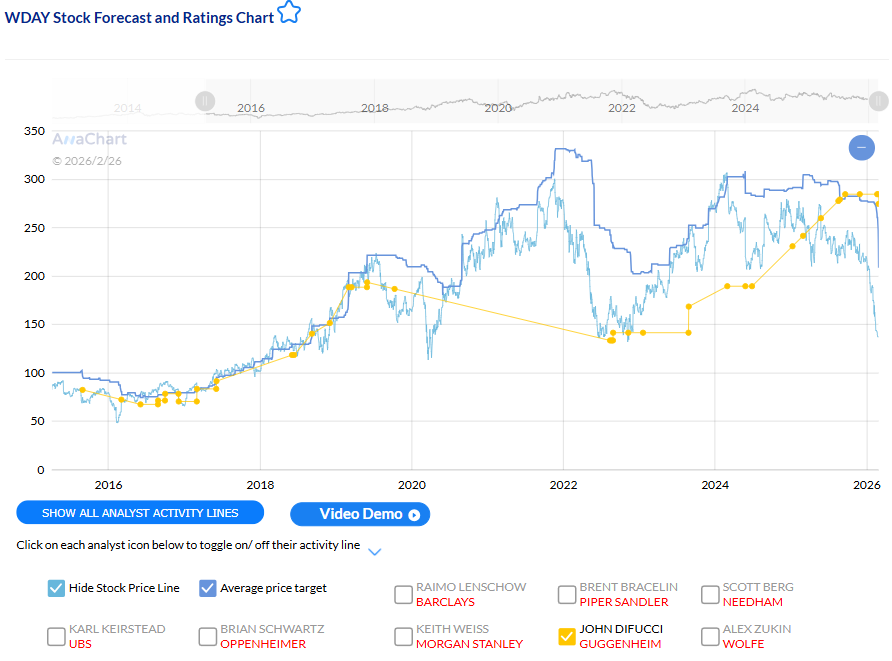
Which Analyst Has the Current Best Track Record on WDAY?
John DiFucci of Guggenheim currently ranks among the top performers on WDAY, with an 84.62% price target hit ratio across 26 predictions. His average time to target is 212 days, reflecting consistent alignment between target setting and price realization.
CAVA Crosses $1 Billion Revenue Milestone
CAVA delivered a quarter that exceeded expectations on nearly every front. Full-year revenue crossed $1 billion for the first time. 2026 guidance also came in ahead of analyst estimates, prompting a broad round of price target increases.
For the fourth quarter of 2025, CAVA reported revenue of $275.0 million, above analyst estimates. Adjusted EPS of $0.04 beat the consensus of $0.00. Same-restaurant sales grew 0.5%, supported by a 1.9% benefit from menu pricing and product mix, partially offset by a 1.4% decline in guest traffic. The company outlined plans to open 74 to 76 new restaurants in 2026, with a long-term target of more than 1,000 locations by 2032.
2026 same-store sales guidance of 3% to 5% came in ahead of prior analyst expectations. Early first-quarter trends were already tracking above the upper end of the range.
Analysts Adjust CAVA Price Targets Following Earnings
Revisions were uniformly upward, with analysts across multiple firms raising price targets in response to the earnings beat and stronger-than-expected guidance.
- Andrew Charles (TD Cowen) maintained a Buy rating and raised his price target to $90 from $85.
- Chris O’Cull (Stifel) maintained a Buy rating and lifted his price target to $90 from $75.
- Jake Bartlett (Truist Securities) maintained a Buy rating and raised his price target to $85 from $80.
- Brian Mullan (Piper Sandler) maintained his rating and raised his price target to $85 from $71.
- Sarang Vora (Telsey Advisory Group) maintained an Outperform rating and raised his price target to $88 from $85.
- Danilo Gargiulo (Bernstein SocGen) maintained his rating and raised his price target to $84 from $75.
- Dennis Geiger (UBS) maintained a Neutral rating and raised his price target to $75 from $69.
- Brian Vaccaro (Raymond James) reiterated a Market Perform rating.
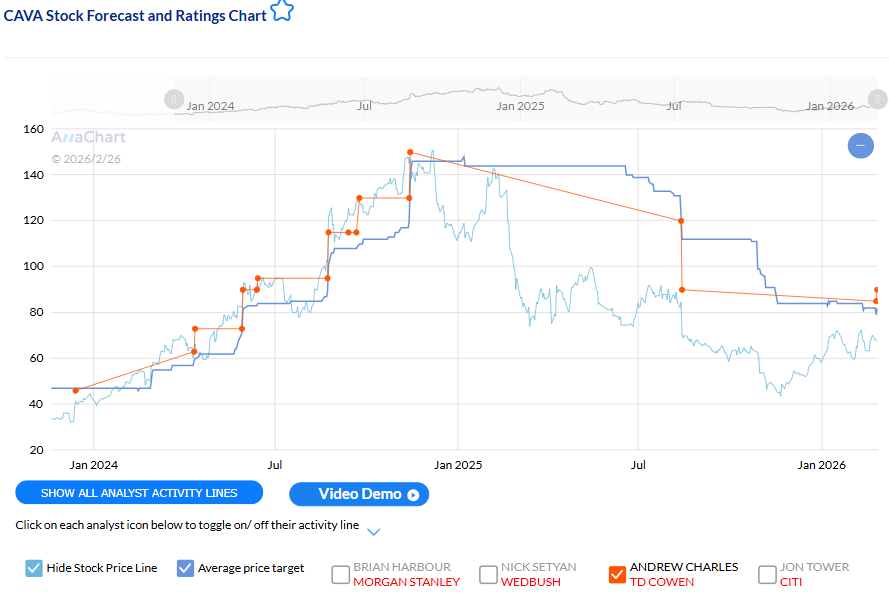
Which Analyst Has the Current Best Track Record on CAVA?
Andrew Charles of TD Cowen currently ranks among the top performers on CAVA, with an 88.89% price target hit ratio across 9 predictions. His average time to target is 28 days, reflecting consistent alignment between target setting and price realization.
Home Depot Posts Largest EPS Beat in Years
Meanwhile, Home Depot delivered its strongest earnings beat in multiple quarters with management providing cautious commentary on housing market conditions and large-ticket consumer demand.
The company reported fourth-quarter 2025 adjusted EPS of $2.72, topping the consensus estimate of $2.52 by $0.20. Revenue of $38.20 billion exceeded expectations of $38.01 billion. Transactions declined 1.6% in the quarter but were partially offset by a 2.4% rise in average ticket size. Home Depot also raised its quarterly dividend by approximately 1.3% to $2.33 per share, marking 39 consecutive years of dividend payments.
For FY2026, the company guided for total sales growth of 2.5% to 4.5%. Comparable sales growth was guided to flat to 2.0%, with adjusted EPS of $14.69 to $15.28. But CEO Ted Decker cautioned that customers remain hesitant to commit to large-ticket projects amid affordability concerns. Housing turnover also remained well below long-term averages. Telsey Advisory Group analyst Joseph Feldman noted that the implied comparable sales figure at the midpoint of guidance would represent the strongest result in three years. He also cited Home Depot’s continued share gains among professional customers as a structural positive.
Analysts Adjust Home Depot Price Targets Following Earnings
Analyst revisions were broadly constructive, with the majority of firms raising price targets in response to the earnings beat. Increases remained measured, though, against a cautious macro backdrop.
- Michael Baker (DA Davidson) maintained a Buy rating and raised his price target to $445 from $407.
- Jonathan Matuszewski (Jefferies) maintained a Buy rating and lifted his price target to $454 from $424.
- Joseph Feldman (Telsey Advisory Group) maintained an Outperform rating and raised his price target to $435 from $410.
- Scot Ciccarelli (Truist Securities) maintained a Buy rating and raised his price target to $424 from $405.
- Steven Forbes (Guggenheim) reaffirmed a Buy rating and raised his price target to $425 from $400.
- Zachary Fadem (Wells Fargo) maintained an Overweight rating and raised his price target to $420 from $395.
- Simeon Gutman (Morgan Stanley) maintained an Equal Weight rating and raised his price target to $420 from $412.
- Robert Ohmes (BofA Securities) maintained a Buy rating with a price target of $430.
- Zhihan Ma (Bernstein SocGen) maintained a Market Perform rating and raised his price target to $390 from $381.
Analyst views on the WDAY, CAVA, and HD price targets are documented in full below, including each target change, rating action, and date.
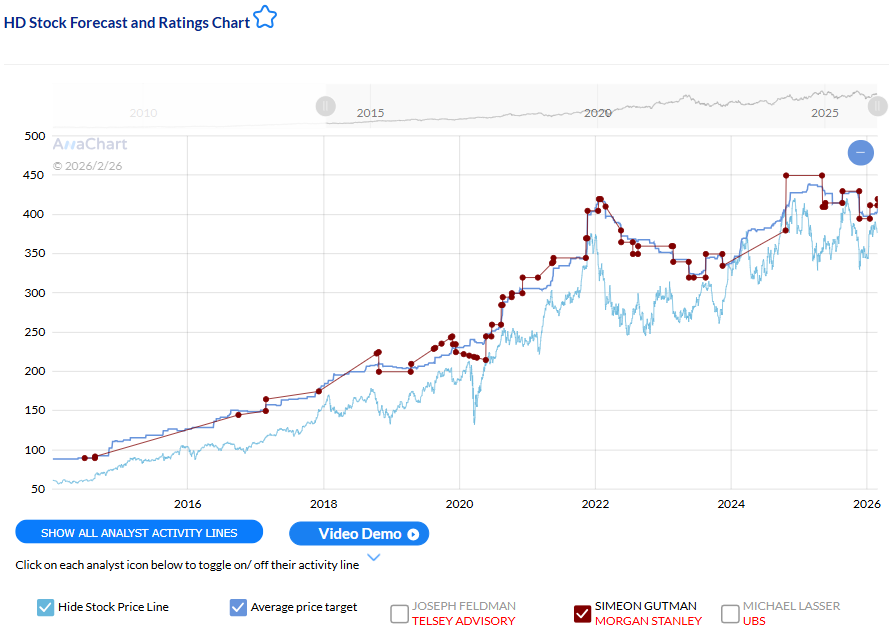
Which Analyst Has the Current Best Track Record on HD?
Simeon Gutman of Morgan Stanley currently ranks among the top performers on HD, with an 88.89% price target hit ratio across 36 predictions. His average time to target is 346 days, reflecting consistent alignment between target setting and price realization.
What happened next
This update names 34 calls with a price target across Workday, CAVA and Home Depot. The table has all 18 Workday calls and the first call named for CAVA and for Home Depot. We checked the Workday calls against AnaChart’s daily prices up to October 30, 2026.
The post does not date the calls. We used AnaChart’s call records where they hold the call, and otherwise February 25, 2026, the first trading day after Workday’s report. The records place Brent Thill’s and Keith Weiss’s moves on February 23, before the report. AnaChart has no price file for CAVA or Home Depot, so those two rows are not checked.
On a phone, swipe the table sideways to see every column.
| Analyst, firm | Stock | Date | Rating | Target | Price that day | Reached since? | Close 30 Oct 2026 |
|---|---|---|---|---|---|---|---|
| Brent Thill, Jefferies | WDAY | 23 Feb 26 | Downgrade to Hold from Buy | $325 to $150 | $129.21 | Yes, 6 Mar 26 (11 days) | $197.82 |
| Kirk Materne, Evercore ISI | WDAY | 25 Feb 26 | Downgrade to In Line from Outperform | $200 to $160 | $133.15 | Yes, 28 Jul 26 (153 days) | $197.82 |
| J. Derrick Wood, TD Cowen | WDAY | 25 Feb 26 | Downgrade to Hold from Buy | $155, old not stated | $133.15 | Yes, 1 Jun 26 (96 days) | $197.82 |
| Gil Luria, DA Davidson | WDAY | 25 Feb 26 | Maintained, not named | $250 to $125 | $133.15 | Yes, 25 Feb 26 (0 days) | $197.82 |
| Jason Celino, KeyBanc | WDAY | 25 Feb 26 | Overweight, maintained | $260 to $155 | $133.15 | Yes, 1 Jun 26 (96 days) | $197.82 |
| Karl Keirstead, UBS | WDAY | 25 Feb 26 | Maintained, not named | $170 to $130 | $133.15 | Yes, 25 Feb 26 (0 days) | $197.82 |
| Billy Fitzsimmons, Piper Sandler | WDAY | 25 Feb 26 | Maintained, not named | $135, old not stated | $133.15 | Yes, 26 Feb 26 (1 day) | $197.82 |
| Robert Simmons, Rosenblatt | WDAY | 25 Feb 26 | Buy, maintained | $150, old not stated | $133.15 | Yes, 6 Mar 26 (9 days) | $197.82 |
| Ken Wong, Oppenheimer | WDAY | 25 Feb 26 | Maintained, not named | $165, old not stated | $133.15 | Yes, 29 Jul 26 (154 days) | $197.82 |
| Keith Weiss, Morgan Stanley | WDAY | 23 Feb 26 | Equal Weight, maintained | $280 to $200 | $129.21 | Yes, 13 Aug 26 (171 days) | $197.82 |
| Michael Turrin, Wells Fargo | WDAY | 25 Feb 26 | Overweight, maintained | $255 to $180 | $133.15 | Yes, 7 Aug 26 (163 days) | $197.82 |
| Rishi Jaluria, RBC Capital | WDAY | 25 Feb 26 | Outperform, maintained | $220 to $180 | $133.15 | Yes, 7 Aug 26 (163 days) | $197.82 |
| Mark Murphy, JPMorgan | WDAY | 25 Feb 26 | Overweight, maintained | $190, old not stated | $133.15 | Yes, 13 Aug 26 (169 days) | $197.82 |
| Daniel Jester, BMO Capital | WDAY | 25 Feb 26 | Outperform, maintained | $204 to $182 | $133.15 | Yes, 7 Aug 26 (163 days) | $197.82 |
| Mark Marcon, Baird | WDAY | 25 Feb 26 | Maintained, not named | $195, old not stated | $133.15 | Yes, 13 Aug 26 (169 days) | $197.82 |
| Raimo Lenschow, Barclays | WDAY | 25 Feb 26 | Overweight, maintained | $230 to $200 | $133.15 | Yes, 13 Aug 26 (169 days) | $197.82 |
| Mark Moerdler, Bernstein SocGen | WDAY | 25 Feb 26 | Maintained, not named | $298 to $214 | $133.15 | Yes, 13 Aug 26 (169 days) | $197.82 |
| Scott Berg, Needham | WDAY | 25 Feb 26 | Buy, kept | $300 kept | $133.15 | No | $197.82 |
| Andrew Charles, TD Cowen | CAVA | Not stated | Buy, maintained | $85 to $90 | n/a | Not checked: no AnaChart price file | n/a |
| Michael Baker, DA Davidson | HD | Not stated | Buy, maintained | $407 to $445 | n/a | Not checked: no AnaChart price file | n/a |
Of the 18 Workday targets, 16 sat above the stock’s close on the day they were set and two below it. By October 30, 2026, 15 of the 16 above the price and both below it had been reached. The quickest two, Gil Luria’s $125 and Karl Keirstead’s $130, both came on the day of the call. The slowest took 171 days (Keith Weiss, $200). The median wait was 154 days. Workday closed at $197.82 on October 30, 2026, against a median new target of $172.50.
How we checked
Prices are raw daily highs and lows from AnaChart’s price files. They are not adjusted for dividends. A target counts as reached on the first day the stock traded at it: the daily high for a target above the price on the call date, the daily low for a target below it. “Price that day” is the close on the call date. Days are calendar days from the call. Data runs to October 30, 2026.
Michael Muchugia wrote this update. Mathew Auto, the byline of AnaChart’s research desk, edited it later and added what happened next, checked against AnaChart’s price records.